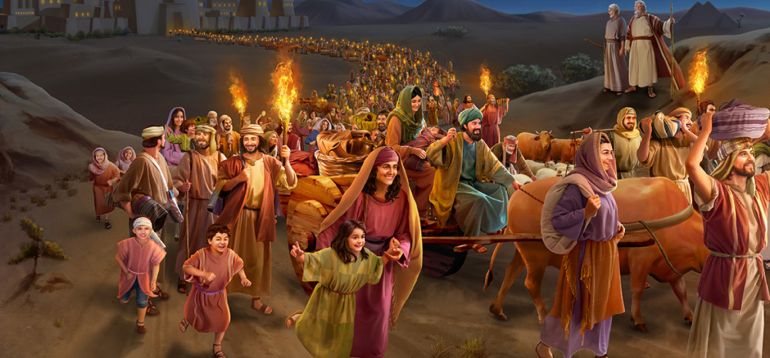
The exodus of the Jews from Egypt and the receiving of the Ten Commandments at Mount Sinai are pivotal events that shaped Israel as God’s chosen people and laid the foundation for its doctrine.
The Exodus was of such immense significance to the people of Israel that this event is mentioned over 60 times in Scripture. More than a hundred references indicate that the Exodus was determined by God’s plan and was a great act of the Lord.
It is strange that an event of such magnitude is not reflected in the traditions of neighbouring peoples. Egyptian sources contain no accounts whatsoever of the arrival, enslavement or exodus of the Jews.
When did the Exodus take place?
Two groups of biblical texts regarding the dating of the Exodus are mutually exclusive. According to 1 Kings 6:1, the Exodus took place in 1447–46 BC:
Now it came about in the four hundred and eightieth year after the sons of Israel came out of the land of Egypt, in the fourth year of Solomon’s reign over Israel, in the month of Ziv which is the second month, that he began to build the house of the Lord.
In Judges 11:26:
‘While Israel lived in Heshbon and its villages, and in Aroer and its villages, and in all the cities that are on the banks of the Arnon, three hundred years, why did you not recover them within that time?’
In this case, from around 1400 BC, the Israelites, under the leadership of Joshua, conquered the peoples inhabiting the Promised Land.
The early dating of the Exodus to the mid-15th century BC does not correspond to the historical situation: Egypt was experiencing a period of prosperity and controlled Canaan. These circumstances do not correspond to the biblical context: a period of disasters in Egypt and the absence of Egyptian control in Canaan. Moreover, the Delta was not the residence of the Egyptian kings in those years, and the future cities of Pithom and Per-Ramses were still nothing more than forgotten wastelands.
These biblical passages are contradicted by the account in the Book of Exodus, which states that
“And they built for Pharaoh storage cities, Pithom and Raamses” (Ex 1:11).
Per-Ramses and Pithom were in fact rebuilt or repopulated in the mid-13th century BC, meaning the Exodus could have taken place around 1250 BC. This is the so-called ‘late dating’, which in turn is also not supported by modern archaeologists.
The discovery of Pharaoh Merenptah’s stele has raised new questions about the Exodus of the Jews from Egypt.
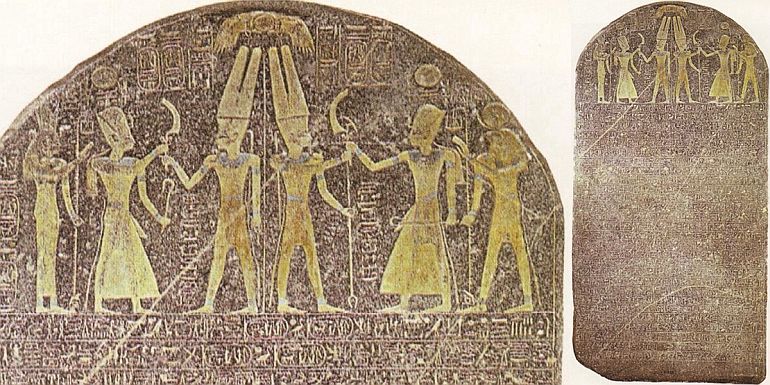
It is dated to 1208 BC and mentions the pharaoh’s victories over the city-states of Canaan and the people of Israel:
‘Canaan has been ruthlessly plundered… Ashkelon has been conquered, Gezer captured, Yanoam destroyed, Israel laid waste, its seed has vanished.’
The earliest non-biblical mention of the Israelites proves that Israel already existed as a people known in Egypt in 1208 BC. According to the later dating of Exodus, the arrival of the Hebrews in Canaan may have been around 1175 BC, but this contradicts the account on the Merneptah Stele.
The Bible states that the pharaoh and his entire army drowned in the Red Sea (Exodus 14:28).
How, then, could Egypt have possessed the military might capable of conquering numerous peoples, as recorded on the stele from the time of Merenptah?
No hundreds of chariots have been found lying at the bottom of any body of water resembling the Red Sea.
The mummy of Ramses II has survived, and much is known about his reign from other sources. He never lost millions of slaves or his entire army. His thirteenth son and successor, Merneptah, ruled successfully and possessed a vast army capable of subjugating other peoples. Egypt remained a dominant world power in the mid-13th century BC.
The body of water where Pharaoh’s army perished is referred to in the ancient Hebrew text as יַם-סוּף — the ‘Sea of Reeds’:
‘and what He did to Egypt’s army, to its horses and its chariots, when He made the water of the Sea of Reeds’ (Deut. 11:4).
Since reeds grow only in fresh water, this most likely referred to the reed-filled marshes near the lakes of the Nile Delta.
However, in 1 Kings 9:26, the name ‘Yam Suf’ clearly refers to the Gulf of Eilat (Gulf of Aqaba) on the Red Sea:
‘ King Solomon also built a fleet of ships in Ezion-geber, which is near Eloth on the shore of the Sea of Reeds, in the land of Edom’
This confusion over terminology has affected biblical translations. The ‘Sea of Reeds’ in Exodus is translated in the Septuagint as Ερυθρὰ θάλασσα — ‘Red Sea’. This error also found its way into the books of the New Testament (Acts 7:36, Hebrews 11:29).
The Number of Participants in the Exodus
According to Exodus 12:37, there were around 600,000 men among the Israelites who fled Egypt.
Interestingly, the Hebrew word ‘elef’ (thousand) also means a family or ‘the inhabitants of a single tent’. In that case, the number of Israelites in the Exodus would have been around 3,000–5,000 people.
However, the Book of Numbers gives a precise figure: 603,550 men, not counting the 23,000 Levites (Num 1:46–47). Therefore, the theory that there were 600 detachments is ruled out.
The size of Ramses II’s army at the Battle of Kadesh (13th century BC) was around 20,000 warriors. The Hittites assembled an army of 37,000 men at that time, which was considered the largest of the armed forces in existence at the time.
Shams-Adad (1800 BC, Assyria) claimed to have assembled an army of 60,000 men for the siege of Nurrugum.
If Israel had had an army of 600,000 men, what was there for it to fear?
Did 2–3 million Israelites leave, including their wives and children? It would have been impossible to feed such a large population in the Nile Delta region.
According to Exodus 1:5, Jacob’s clan in Egypt numbered 70 people, and according to Exodus 6:16–20, Moses belonged to the fourth generation of the people of Israel.
How could the great-great-grandchildren of Jacob’s twelve sons number more than 2 million?
Even the most optimistic estimates of the population of ancient Egypt suggest a figure of between 2 and 4 million people. Clearly, they could not all have been Israelites who left Egypt.
Anachronisms
In historical scholarship, an anachronism refers to the erroneous attribution of events to a different time or era than the actual chronology.
The place names in the Book of Exodus reflect the historical context of Egypt no earlier than the 7th century BCE.
The Bible mentions camels among Pharaoh’s livestock (Ex 9:3), as well as in the account of Joseph being sold into slavery by his brothers (Gen 37:25).
Camels were domesticated approximately between the 11th and 10th centuries BCE and were used as such in the Middle East only after 1000 BCE.
The story of Joseph mentions a camel caravan carrying ‘storax, balm and frankincense’, which were the main products of the Arabian trade that flourished in the 8th–7th centuries BC.
Another anachronism is noted in the text of Exodus 1:11, which is linked to Genesis 47, where within the same narrative, the land given to the Jews under Joseph is first called Goshen (Gosen — Genesis 47: 3–6), and then as Ra’amses (Genesis 47:11).
Here, the form of the biblical name Ra’amses, characteristic of the later literary tradition, dates approximately to the 8th–7th centuries BC.
It seems strange that the Egyptians should have feared an invasion from the east, given that, prior to the Assyrian invasion in the 7th century, Egypt had never been invaded from that direction. In the account of the Exodus, the pharaoh fears that the Israelites will collaborate with the enemy. These dramatic touches would only make sense against the backdrop of the invasion of a significantly weakened Egypt by the Assyrians, Babylonians and Persians in the 7th–6th centuries BC.
Archaeologists have found numerous traces of the Bedouins who inhabited the Sinai Peninsula for ten thousand years, but no archaeological evidence of a prolonged sojourn by the Israelites in this region has yet been discovered.
Scientists have searched for traces of the 600,000 Israelite warriors and their families in southern Sinai. The Early Bronze Age is well represented here, whilst the Negev features the Middle Bronze Age, dating from 3150 to 2000 BC. However, this was followed by a long period of desolation. Nothing relating to the era of the Exodus has been found in Sinai or the Negev region. Nor are there thousands of graves of worshippers of the golden calf here.
In the Negev desert, on the border between the Sinai Peninsula and Canaan (the Southern District of Israel), lay the oasis of Kadesh. Deuteronomy and Numbers speak of a prolonged stay by the Exodus Jews at Kadesh. The Israelites reached Kadesh after an 11-day journey from Mount Sinai, yet remained there for some 38 years. However, archaeological excavations have uncovered traces of settlements there dating only from the 10th to 7th centuries BC.
According to the Bible, the king of Edom refused to allow the Israelites to pass through his land (Numbers 20:14). Archaeological evidence suggests that the territory of Edom was sparsely populated by nomadic tribes during the Bronze Age, and the Edomite state first appeared in the 7th century BC.
The Pentateuch mentions that the Israelites defeated five kings of the Midianites and plundered their cities (Num. 31:1–12), yet urbanisation of the land of Midian is not known until the 7th century BC.
The Bible reports that the Israelites encountered the Canaanites in the north of the Negev desert. However, the settlements mentioned, such as Arad (Num. 21:1–3), were not inhabited from the Early Bronze Age until the 8th century BCE.
Jericho, as the Bible recounts, was the first city of Canaan to be captured by the Hebrews. Yet excavations have shown that by the end of the Bronze Age, there was no fortified settlement, not even a village, at the site of Jericho.
The city of Gai, according to the biblical account, was the second to be captured. However, excavations at the site of the city, presumably identified as Gai, have shown that it was completely destroyed around 2250 BC and lay in ruins for about a thousand years, until a Jewish village emerged on the site around 1200 BC.
The Bible states that the cities of Canaan were fortified and ‘reached up to the heavens’. But in reality, Canaan at the end of the Bronze Age was a province of Egypt, under its complete control; the Egyptians deliberately prevented the existence of fortified cities, and there were no walls that could be destroyed, as described in the story of Jericho. The absence of walls in all the cities of Canaan at the end of the Bronze Age is confirmed by archaeological evidence.
In Canaan, which was entirely under Egyptian control, there were Egyptian garrisons throughout the country, and the nomadic Jews simply could not have conquered a land where Egyptian troops were stationed everywhere. Yet the Bible makes no mention of the presence of Egyptians in Canaan at the end of the Bronze Age.
Let’s sum up
The stories of the biblical patriarchs are ordinary myths, just like the Exodus of the Israelites from Egypt and the campaigns of Joshua.
The biblical account of the Exodus is a typical ethnological legend designed to explain the origins of the Israeli people.
This legend was formulated around the 7th century BCE to inspire the ancient Jews to resist the world empires of the time – Egypt, Assyria and Babylon.
Literature
Finkelstein Israel, Silberman Neil Asher. Finkelstein, I., Silberman, NA., The Bible Unearthed: Archaeology’s New Vision of Ancient Israel and the Origin of Its Sacred Texts. Free Press, 2001. 385 pp
Aleksandr Usatov
ausatov@protonmail.com