Recently, the remains of three enslaved individuals were discovered in Mexico. They had been transported to the New World in the early 16th century by Spanish slave traders and colonists. Isotopic, genetic, and osteological analyses showed that they were Africans—among the first African slaves in the Americas. Researchers identified numerous deformities and injuries indicating frequent beatings, as well as traces of two serious diseases—hepatitis B and yaws.
It is interesting to consider what relationship the Christian Church has to the history of American slavery.
Slavery in the New Testament
In the early letters of the Apostle Paul and in the Gospels, one can easily find expressions of the “good news of freedom.” Unlike the “rulers of the nations,” Christians and their leaders are not to regard their brothers as slaves; rather, they are called to serve and help the weak (Matthew 20:25–27).
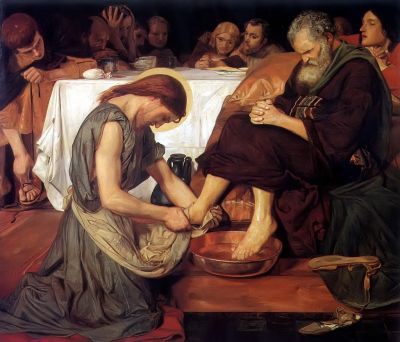
The Son of God “emptied Himself, taking the form of a slave” (Philippians 2:6–7), which is far removed from the behavior of rulers within the Roman system of domination.
Sending the runaway slave Onesimus back to his master, the Apostle Paul gave Philemon a clear instruction:
“no longer as a slave but more than a slave, a beloved brother” (Philemon 1:10–16).
Time passed. By the end of the 1st century, in letters mistakenly attributed to Paul, signs of recognition of slaveholding rights within the Church began to appear.
In the so-called “disputed” epistles to the Ephesians and Colossians, slavery is treated as a given norm, though masters and slaves are urged toward mutual respect and justice (Ephesians 6:5–9; Colossians 3:22; 4:1).
At the turn of the 1st–2nd centuries, in the Pastoral Epistles, there is not even a notion of reciprocity between masters and servants; only instructions to slaves are given:
“Let all who are under the yoke of slavery regard their masters as worthy of all honor” (1 Timothy 6:1).
A similar statement is found in the First Epistle of Peter:
“Slaves, be subject to your masters with all respect, not only those who are good and gentle but also those who are dishonest” (1 Peter 2:18).
In the early centuries of the Church, the “good news of freedom” occasionally appeared within Christian circles.
The Imperial Church and the Slaves
By the end of the 4th century, John Chrysostom expressed views close to a moral condemnation of slavery:
“I possess, you say, male and female slaves. What arrogance and audacity! These words are a cry of protest against God… I possess slaves! For how much did you buy them? What did you find in the world that could be worth a human being? What price do you assign to reason? How many obols did you pay for the image of God?”
However, such ideas did not become the dominant position of the Church.
The state, having become Christian, did not even consider abolishing slavery. According to Emperor Justinian,
“the main distinction in human rights is that all people are either free or slaves, and there is no third intermediate category in Roman law.”
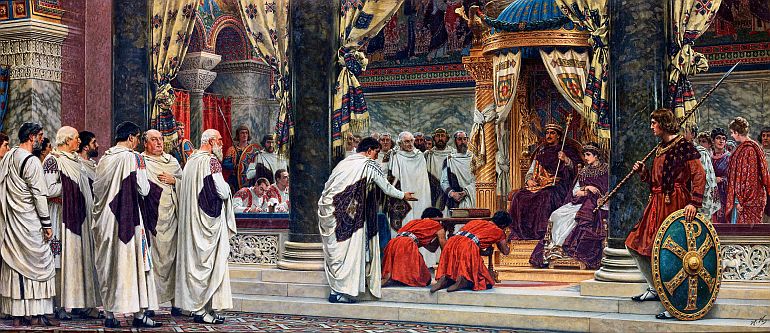
Following the state, the Church also ceased to oppose slavery.
The extent to which ecclesiastical authority did not resist slavery is evident from the fact that bishops, clergy, and church institutions owned slaves. Basil the Great writes:
“I hereby inform your good conscience that this presbyter has received most of his slaves from me, and they were given to him by my parents as a reward for my upbringing.”
In the 11th–13th centuries, the Catholic Church in Western Europe was one of the largest landowners, controlling approximately:
— 15–25% of the land in France,
— 20–35% in the Holy Roman Empire,
— about 25% in England after the Norman Conquest.
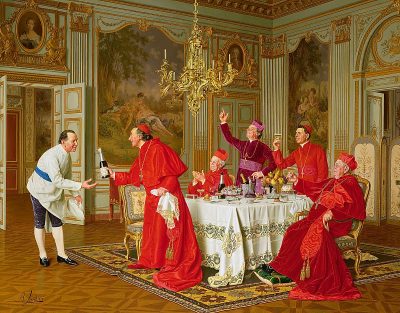
The economy of ecclesiastical estates was fully integrated into the feudal system and based on the labor of dependent peasantry (serfdom), rather than classical slavery. Dependency was expressed in restricted mobility and compulsory dues (corvée and rent), varying by region and period.
At this time, some Italian maritime republics continued to engage in slave trade, and slaves from Africa began to be imported into Spain.
The Catholic Church’s encouragement of the slave trade from Africa
The bulls “Dum Diversas” (1452) and “Romanus Pontifex” (1455), issued by Pope Nicholas V, formed a unified legal and religious framework for Portuguese colonial expansion. The first granted King Afonso V of Portugal the right to wage war against “Saracens and pagans” and to seize their lands and property. The second officially confirmed and extended these powers to all “enemies of Christendom.” The main outcome of both bulls was an official papal sanction of enslavement: they explicitly authorized the capture and subjugation of prisoners of war and their conversion into “perpetual servitude” (“perpetua servitus / servitus perpetua”).
Spain and Portugal became leaders of the Age of Discovery and established systems of slavery in the newly discovered territories of the Americas.
Soon after Columbus’s discovery of the New World, Spanish colonists arrived there. Their first concern was obtaining economically efficient labor. Indigenous peoples, who looked different, spoke unfamiliar languages, and were not Christians, came to be treated as labor attached to the land of their new masters.
The native population (called “Indians”) was forcibly relocated to special settlements (many dying along the way), where they were assigned as labor resources to colonial masters.
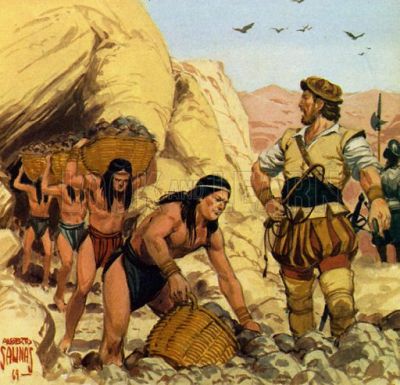
One of the most well-known proponents of the idea of indigenous inferiority was the philosopher, theologian, and historian Juan Ginés de Sepúlveda (1490–1573). Drawing on Aristotle’s ideas of the inequality of peoples and the subordination of the weak to the strong, he justified harsh measures against the indigenous population, whom he considered barbarians incapable of rational self-government.
Conquistadors brutally exploited the natives for profit, including enslaving them; many died quickly or attempted to escape.
Soon after the conquest of the New World, archbishoprics and bishoprics were established in the Americas, and numerous monasteries were founded (by the early 17th century, over 400 in New Spain alone). From the beginning, monks and priests accompanied the conquistador expeditions, sometimes justifying their atrocities with ecclesiastical authority, and at other times restraining abuses and defending indigenous peoples.
The conquest led to a dramatic decline in the indigenous population. Native peoples resisted oppression, staged revolts, and sometimes created centers of resistance in remote forests or mountains that the Spanish were unable to capture for years.
Debates over the treatment of indigenous peoples continued, involving even the papal throne. One colonist, Bartolomé de las Casas, came to believe that indigenous peoples were fully human like the Spaniards, and that what was being done to them in the New World was ungodly and unlawful from a Christian perspective.
From that moment on, Las Casas renounced his slaves and began a vigorous campaign for the abolition of indigenous slavery. He wrote and distributed (including to the Spanish king) his “Account of the Destruction of the Indies,” demanding a total ban on the use of indigenous labor as slavery and proposing a system of wage labor instead. He also suggested solving labor shortages through African slaves, since the enslavement of Africans was considered justified both legally and theologically.
Christians of that time believed that Africans were descendants of Ham and therefore inferior beings destined for slavery.
According to the biblical tradition, when Noah learned of Ham’s wrongdoing, he said:
“Cursed be Canaan; a servant of servants shall he be to his brothers” (Genesis 9:24–25).
In 1537, Pope Paul III issued a bull recognizing indigenous peoples as fully human and forbidding their enslavement. The Spanish government issued a decree banning the enslavement of Indigenous peoples, and immediately afterward issued an edict allowing the importation of African slaves into the colonies.
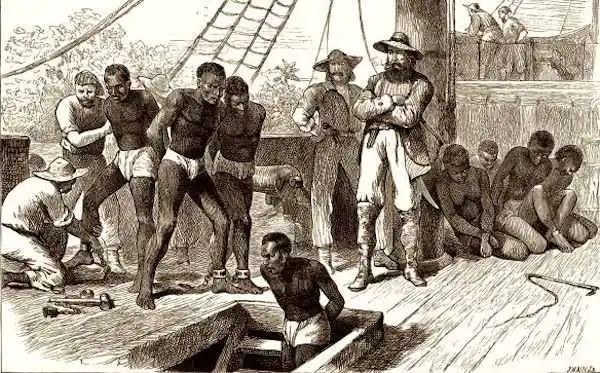
As a result, Spaniards and Portuguese began bringing Africans to the Americas. At some point, Africans came to be regarded more as “things” or property than as persons.
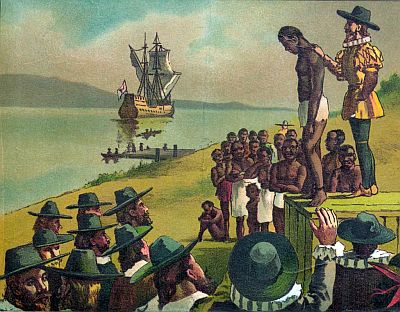
In many colonies, racial regimes developed in which African ancestry became the primary basis for hereditary slavery.
The Anglican Church sanctioned the 1667 law in Virginia stating that
“baptism does not alter the condition of a person, whether slave or free.”
The founding act of South Carolina declared:
“Every free man of Carolina shall have absolute power and authority over his negro slaves, of what belief or religion soever they may be.”
Thus, a significant part of ecclesiastical structures supported or accommodated the slaveholding order.
Priests, nuns, and religious orders owned large numbers of slaves.
For example, the largest monastery in Mexico bordered a slave market. Nuns purchased slaves to serve in monastic households. The Brazilian writer Joaquim Nabuco (1849–1910) argued that
“no priest ever attempted to stop a slave auction; no one ever condemned the religious regime of the slave quarters. The Catholic Church, despite its immense power in the country, never advocated emancipation in Brazil.”
As Foster noted, religion in the hands of planters became
“the most powerful means of providing moral justification for their slave system.”
Defenders of slavery used Scripture and Church history to argue for its “divine legitimacy”. They claimed that slavery had always been pleasing to God, since even the 10th Commandment states: “You shall not covet your neighbor’s house… or his male or female slave” (Exodus 20:17).
By citing such biblical passages, apologists of slavery sought to shape public opinion in favor of recognizing slavery as one of the foundations of “civilized and Christian life.”
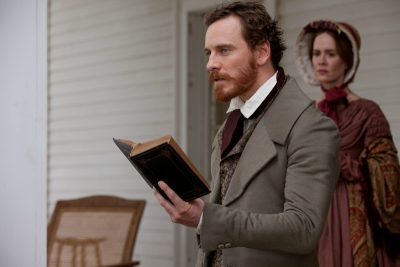
The film “12 Years a Slave” depicts how Christian slaveholders appealed to Scripture to justify brutality and racial discrimination.
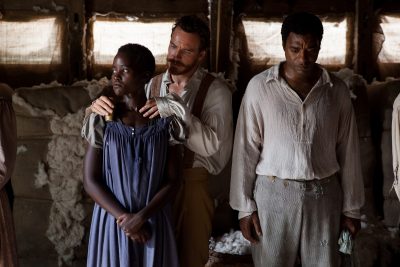
It must be understood that even Christian missionary work at the time often served the purposes of slavery.
The Anglican priest Morgan Godwyn argued in “The Negro’s and Indian’s Advocate” that converting slaves to Christianity would make them more obedient due to fear of divine punishment, thus strengthening the slave system.
Cotton Mather similarly wrote in “The Negro Christianized” (1706):
“Be assured that as Christians they will serve much better.”
Even during the “Great Awakening” of the 18th century, enslaved people in churches did not enjoy equal rights; Black worshippers were required to sit in separate galleries.
In the 19th century, Bishop John Hughes of New York and Bishop John England of South Carolina both opposed abolitionist movements, calling them anti-patriotic.
At that time, Cuba remained one of the last and most important “sugar colonies” of the Spanish Empire. The local economy depended entirely on the labor of African slaves imported from Africa.
The Catholic Church in Cuba was one of the largest corporate slaveholders and landowners.
Monasteries, cathedrals, and high-ranking clergy owned vast plantations (ingenios) and hundreds of slaves. When Spain began seriously discussing abolition under pressure from Britain and liberal reforms, the ecclesiastical elite of Santiago de Cuba panicked. The archbishop wrote letters to the Spanish crown pleading not to abolish slavery, arguing that slavery in Cuba was an act of mercy, as enslaved Africans were being rescued from “African paganism” and brought to Christian Cuba for baptism and salvation.
Regarding slavery, the position of high Catholic clergy was clearly expressed by John England. In an 1840 letter to Secretary of State John Forsyth, he wrote that slavery was considered by the Church, with the Pope as its highest authority, to be an institution compatible with the natural order and lawful under divine and human law.
Appealing to a case before the Supreme Ecclesiastical Court of the Reformed Church, the Dutch Reformed pastor S. B. Howe argued that neither the Apostles nor Christ ever condemned slavery, and that the Old Testament prophets themselves owned slaves, therefore Scripture does not prohibit slavery.
In 1860, southern Presbyterian synods, including church structures in South Carolina, held that slavery was not a sinful institution and could be justified by Scripture.
Among American clergy, the most active opponents of slavery were not representatives of historic Christianity—Catholics or Anglicans—but Quakers. They advocated racial equality and rejected theories of African inferiority.
Interestingly, in 1697 the Quakers sought to draw Peter the Great’s attention to the condition of serfs and the need for education for common people.
Unlike in America, in Russia oppression was not based on race or religion; serfs were ethnically similar to their masters. Traditionally, the Russian Orthodox Church supported systems of domination and exploitation. Even two years before the abolition of serfdom, Saint Ignatius Brianchaninov defended serfdom as “lawful and divinely instituted.”
“The Church, both universal and Russian, through the Holy Fathers, has never spoken of the abolition of civil slavery.”
Conclusion
The history of the Church and slavery challenges the myth that religion is a primary source of moral progress. Often, it functioned as a conservative force that sanctified existing social orders. Rather than leading moral development, the Church frequently followed prevailing social norms.
Christianity, from a “gospel of freedom,” quickly became a worldly religion supporting existing socio-economic and political systems of domination.
“Passages attributed to Paul endorse slavery, subordination of women, etc. They were used throughout much of Christian history to justify systems of oppression…” (Marcus Borg & John Dominic Crossan)
While historical analysis of the Church’s relation to slavery may seem remote, slavery continues to have modern implications in forms such as exploitation, domestic violence, and forced labor.
The Church’s silence on slavery over centuries represents one of its greatest moral catastrophes. It cost millions of people their freedom, dignity, and lives.
P.S.
In 2026, Pope Leo XIV, in the encyclical “Magnifica Humanitas”, condemned all forms of slavery, human trafficking, and commodification of human beings, and acknowledged the responsibility of the Catholic Church for past forms of support and justification of slavery:
“we cannot deny or diminish how late the Church and society condemned the scourge of slavery… In antiquity and the Middle Ages many people and ecclesiastical institutions owned slaves… the Apostolic See, urged by rulers, issued norms that regulated and at times legitimized subjugation… the Church long tolerated slavery and only later came to its full condemnation… for eighteen centuries the Church did not officially proclaim the full incompatibility of human dignity with slavery… On behalf of the Church I sincerely ask forgiveness for this.”
At the same time, the Orthodox Church even in the 21st century has not amended canonical texts containing references to slavery and other discriminatory provisions.
Having abandoned the “gospel of freedom,” the Church itself became a system of domination infringing upon basic human rights. In the words of Patriarch Kirill, the Russian Church has declared humanism to be an anti-Christian ideology and a heresy.
By rejecting human rights, the Church still relies on biblical citations.
Literature
- Borg, Marcus; Crossan, John Dominic. The First Paul: Reclaiming the Radical Visionary Behind the Institutional Apostle. 2018.
- Basil the Great. Letters. // Works, Part 6. Sergiev Posad, 1892. p. 85.
- History of Spain, Vol. 1: From Ancient Times to the End of the 17th Century. Ed. V. A. Vedyushkin, G. A. Popova. Moscow: Indrik, 2012. pp. 517–533.
- Cotton Mather. The Negro Christianized: An Essay to Excite and Assist that Good Work, the Instruction of Negro-Servants in Christianity (1706).
- Foster, William Z. The Negro People in American History. Moscow, 1955.
- Encyclical Letter “Magnifica Humanitas” of Pope Leo XIV on the Protection of the Human Person in the Age of Artificial Intelligence (2026).