- Preserving Israel’s Identity Among Surrounding Nations
- The Legend of Sodom and Gomorrah’s Destruction as Black PR
- Ritual Cross-Dressing (Prohibition of Cross-Dressing)
- Cult Prostitution
- The Prohibition of Male Homosexual Intercourse in the Context of Cult and Idolatry
- Same-Sex Sex as God’s Punishment for Idolatry
- The Old Testament Prohibition of Male Homosexual Intercourse as a Violation of Gender Roles
- Gender-Hierarchical Concepts of Ancient Philosophers
- The Early Church’s Opposition to Gnostic Forms of Debauchery
- The Personal Experience of Christian Bishops
- Roman Law and Secular Laws on Male Homosexual Intercourse
- Anti-Scientific Ideas of the Ancients
- The Struggle of the Catholic Inquisition Against Sodomites
- The Emergence of the Concept of Sexual Orientation and Homosexuality
- The Return of Millions of People to Soviet Society from Stalin’s Camps
- Conclusions
- Bibliography
Preserving Israel’s Identity Among Surrounding Nations
The Old Testament God Yahweh is a jealous God. To shield the Jews from everyday interaction with neighboring tribes, the Hebrew Bible prohibited forms of sexual behavior and culinary delicacies popular among those tribes (baby goat boiled in its mother’s milk, pork, etc.). An Israelite was not to act like a pagan, for whom sex and eating were part of magical rites:
“Do not intermarry with them, giving your daughters to their sons or taking their daughters for your sons, for that would turn away your children from following me, to serve other gods” (Deut 7:3–4).
The sexual and dietary prohibitions of the Hebrew Bible constituted an ethno-religious boundary (a pedagogical and political measure), not an ontological morality.
The Legend of Sodom and Gomorrah’s Destruction as Black PR
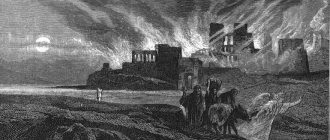
The story of Sodom was meant to explain the origins of the peoples inhabiting Canaan and Transjordan (an etiological myth). It is an example of politically motivated black PR, created by the author of Genesis “retroactively.”
In the biblical account, the inhabitants of Sodom attempted to rape even the Angels of Yahweh, not just righteous Lot (Gen 19:9):
“Where are the men who came to you tonight? Bring them out to us, so that we may know them” (Gen 19:5).
But overall, the story of Sodom is not about sex (that is secondary), but about collective violence and the rejection of God’s messengers. The modern equivalent of the “sin of the Sodomites” is not same-sex love, but the rape of men in prisons.
Ritual Cross-Dressing (Prohibition of Cross-Dressing)
In ancient Near Eastern texts, examples of dressing in the clothes of the opposite sex appear most often in cultic or legal materials. Because of its association with other religions, cross-dressing is called an “abhorrent” in Deuteronomy and was taboo for the ancient Jews (Deut 22:5).
Cult Prostitution
Ritual orgies were an integral part of Canaanite cults and were aimed at ensuring the fertility of the land, livestock, and people. Male temple servants also engaged in cult prostitution. To counteract the influence of foreign cults, the ancient Jews were forbidden to bring the wages of a male prostitute into the temple:
“None of the daughters of Israel shall serve in an illicit shrine; none of the sons of Israel shall serve in an illicit shrine. You shall not bring the fee of a prostitute or the wages of a dog into the house of the Lord your God in payment for any vow, for both of these are abhorrent to the Lord your God” (Deut 23:17–18).
The Prohibition of Male Homosexual Intercourse in the Context of Cult and Idolatry
The Old Testament contains a direct taboo on male homosexual intercourse:
“You shall not do as they do in the land of Egypt, where you lived, and you shall not do as they do in the land of Canaan, to which I am bringing you. You shall not follow their statutes… You shall not lie with a male as with a woman; it is an abomination” (Lev 18:2–3, 22; 20:13).
The text goes on to explain why this is unacceptable:
“Do not defile yourselves in any of these ways, for by all these practices the nations I am casting out before you have defiled themselves. So keep my charge not to commit any of these abominations that were done before you and not to defile yourselves by them: I am the Lord your God” (Lev 18:24, 30).
Sexual relations between two men are mentioned here in the context of the religious rites of the Egyptians and the inhabitants of Canaan.
Indeed, “sodomy was practiced in the ancient Near East in a ritual or magical context. Examples of sodomy are found in Ugaritic mythology” (The IVP Bible Background Commentary).
Some scholars believe this refers to ritual acts in the temples of foreign gods, temple prostitution, and the cultic orgies of the Canaanites. In that case, the text is not about forms of sexuality, but about pagan practices.
Same-Sex Sex as God’s Punishment for Idolatry
In the Bible, God repeatedly promised to take away the understanding of disobedient people as a punishment. In some cases, Yahweh threatened literal clinical insanity (Deut 28:28, 34).
But Yahweh had two more sophisticated options for humiliating disobedient people:
— forcing people to defile themselves with their own sacrifices: to sacrifice their firstborn children, “so that they might know that I am the Lord” (Ezek 20:24–26);
— “For this reason God gave them over to dishonorable passions,” so that they “committed shameless acts with males and received in their own persons the due penalty for their error” (Rom 1:26–27).
Thus, male homosexual intercourse and lesbian relations between women are presented in the Bible as God’s punishment, a form of madness.
The Old Testament Prohibition of Male Homosexual Intercourse as a Violation of Gender Roles
It is possible that the prohibition against lying with a man “as with a woman” means that a man must not assume the female position. In this case, the taboo on the passive role is connected to the patriarchal idea of honor/dominance. The shame here lies in the humiliation of a man’s status as the dominant, something linked to the cultural specificities of the ancient Near East.
Gender-Hierarchical Concepts of Ancient Philosophers
Inhabitants of the late Roman Empire thought in categorical pairs: active/passive, spiritual/physical, order/chaos, form/matter, male/female. These categories were formulated by Aristotle. In his hierarchical model,
“The male is by nature superior, and the female inferior; and the one rules, and the other is ruled» (Politics I.5)
If a man (in the sense of the archetypal principle) begins to act as a “receptive principle,” playing the role of a woman (for example, in a form of sexual behavior), then for Aristotle this logically contradicts the nature of things: that which by nature is active cannot perform the function of the passive.
Aristotle perceived other “category mix-ups” the same way: a slave who behaves like a master, or an animal to which reason is attributed — all these are for him logical incongruities, not simply moral taboos.
If two mature, free men engaged in sexual relations, people in antiquity believed that such a sexual bond was unnatural only for one of the partners — the one who assumed the subordinate position. These ideas of Aristotle influenced orthodox Christianity. For example, Blessed Theophylact of Bulgaria called receptive anal intercourse a disgrace for a man:
“The apostle calls those who are passive in shameful acts ‘malakoi’” (Commentary on the First Epistle to the Corinthians).
Bishops of the 3rd century held similar views:
“Men, maddened by vicious frenzy, have renounced themselves and rush to play another’s role. Seized by unhealthy lust, males rush upon males” (Cyprian of Carthage, To Donatus).
The Early Church’s Opposition to Gnostic Forms of Debauchery
Gnostic Ideas Against Sex
The “Epistle of Barnabas” — a Christian text of the 1st–2nd century that had a significant influence on early Christianity — shows a noticeable Gnostic influence. The author of the “Epistle” presented the biblical prohibition against eating the hare, the hyena, and the weasel to the reader as a prohibition on certain sexual practices: child molestation, switching sexual roles, and fellatio. This “method” was later developed by the presbyter Clement of Alexandria (d. ca. 215). Appealing to the Aristotelian category of “nature,” Clement called some forms of sexual relations between people “unnatural,” for example, anal sex.
Gnostic Exegesis
Followers of the Gnostic Basilides viewed Christ’s words about eunuchs (Matt 19:12) as a reference to the natural characteristics of men:
“Some men are by nature similar to women and follow their habits. It is better for such not to marry. They are eunuchs from birth” (Clement of Alexandria, Stromata).
Gnostic Sexual Rituals
The ritual consumption by men of their own semen (the Eucharistic rituals of the Phibionites, described by Epiphanius of Salamis) suggests that some Gnostics practiced sex that excluded fertilization in order to “destroy the works of the female” (Gospel of the Egyptians), making conception and childbearing impossible.
Manichaean Tendencies and a Principled Aversion to Sex
From the 3rd century onward, Manichaean ideas spread in Christian circles, viewing sexual desire as an instrument of the dark forces. Supporters of Eustathius of Sebaste held a similar view of sexuality, which undoubtedly influenced many monks of the 4th century.
Such anti-sexual ideas contributed to a shift in the focus of adherents of early orthodoxy from the social and religious dimension of the sin of the Sodomites to an exclusively sexual one.
At some point, Byzantine exegetes forgot the biblical discourse of sexual relations between humans and angels (the young male Angels and the men of Sodom, the Sons of God and the daughters of men). As a result, the interpretation of difficult biblical passages was reduced to the condemnation of forms of sexuality.
The inhabitants of Sodom began to be perceived primarily as perverts who daily engaged in unnatural debauchery “only with boys (ἐν παισὶν ἐπεμένοντο)” (St. John Chrysostom).
Thus a new myth about the sin of Sodom appeared in the Ancient Church. It detached itself from its biblical foundation and began to live an independent life. The term “sodomy” came to denote any form of sexual contact not aimed at procreation: extramarital affairs, sex between men; bestiality; anal intercourse; oral sex, etc. In the late Middle Ages, the emphasis shifted toward homosexual contacts between men.
The Personal Experience of Christian Bishops
The greatest saint of the Western Church — Blessed Augustine — lived in his youth in Carthage,
“where all around bubbled the cauldron of unholy loves.”
At that time, Augustine fell in love with a young man:
“Sweet it was to me to love and to be loved, but most of all when I could enjoy the body of my beloved. I defiled the spring of friendship with the filth of lust and darkened its brightness with the infernal desires of passion” (Augustinus Hipponensis. Confessiones III, 1).
Their passionate love affair lasted a year, after which Augustine’s friend fell ill and died. Subsequently, the future saint had numerous relationships with young men, while at the same time sharing his bed with his concubine.
After becoming a bishop, Augustine regretted the sexual pleasures of his youth and sharply rejected the possibility of lawful homosexual relations. Augustine’s view of sex as a “diseased craving of the flesh” had a substantial impact on the formation of Christian teaching: all sexuality began to be viewed through the prism of shame and guilt.
Roman Law and Secular Laws on Male Homosexual Intercourse
At the turn of the 4th–5th centuries, St. John Chrysostom effectively called for the killing of men who have sex with men:
“Whence has this lust burst in, insulting human nature, like enemies? I assert that these men are worse than murderers, for it is better to die than to live after such an outrage… you have destroyed your existence as a man, you have made yourself not a dog, but an animal more contemptible than a dog, and you deserve to be banished from both men and women and stoned.”
On August 6, 390, an edict was issued which entered the Theodosian Code (Codex Theodosianus, 9.7.6):
“All those who have the shameful custom of condemning a male body to perform the role of a woman… must atone for their guilt in avenging flames in the sight of the people.”
In the legislation of Emperor Justinian, male homosexual intercourse was declared “contrary to nature,” linked to God’s wrath, earthquakes, and calamities. It was declared a crime worthy of death, for the state was obliged to root out sin; otherwise “all” would suffer, not only the guilty.
Anti-Scientific Ideas of the Ancients
Archaic consciousness proceeded from the idea of the finiteness of male semen: it could and should be used only for conceiving children. Same-sex relations were considered a “fruitless emission of semen” and, consequently, a waste of a man’s life force. Therefore, they were perceived as undermining masculinity, weakening the body and the lineage, and thus as socially dangerous and prohibited practices:
“A man is so deprived of vital forces by the emission of semen… wherefore the emission of matter destroys health and saps and diminishes the strength of the organism. Sowing is permissible only for the married man… Indiscriminate throwing away of semen is absolutely contrary to nature” (Clement of Alexandria, Paedagogus, Book 1.10).
Moreover, Christian teachers erroneously cited the physiology of animals (the hare and the hyena) to taboo certain sexual practices and positions:
“Even animals are not allowed by nature to emit semen into the passage for excrement… It must be acknowledged by all that nature itself has opposed intercourse of a male with a male. The unnatural position in this case is impermissible” (Clement of Alexandria, Paedagogus).
The Struggle of the Catholic Inquisition Against Sodomites
From the end of the 15th century, the old picture of the world began to collapse in Europe. To overcome social phobias, it was important for ecclesiastical and secular authorities to identify enemies of public peace and execute them publicly. At that time, the “enemies of the people” turned out to be heretics, witches, and sodomites. From Blessed Augustine through Thomas Aquinas, the teaching of the Catholic Church entrenched the conviction that sexual acts without the possibility of conception violate the order of creation (“against nature”) and offend God’s majesty. It was believed that if society tolerated sodomites, God would punish everyone indiscriminately, sending earthquakes, plague, famine, and military defeats. The executions of sodomites were then perceived as the “defense of society.”
The Emergence of the Concept of Sexual Orientation and Homosexuality
The concept of homosexuality emerged very late — in the 19th century. Previously, relations between males were viewed entirely differently.
Acts, rituals, kisses, emotional attachment, and even sexual play were not perceived as manifestations of a specific sexual orientation.
The theme of sexuality in the Bible and the works of the Holy Fathers is considered within the framework of ancient categories of behavior, not the modern concept of orientation:
“Alternating pleasures with pleasures, making love with boys and betraying spouses” (Clement of Alexandria, Paedagogus).
Public morality and church canons did not see anything shameful in forms of male friendship and love (except for anal sex). But in the 20th century, everything changed. Upon encountering any manifestation of emotional attachment (kisses, embraces, etc.), ordinary people unhesitatingly identify the event with the “sin of Sodom,” suspecting that any display of male friendship and tenderness is necessarily accompanied by anal sex (which is a mistake).
This became a catalyst for homophobia and greatly impoverished people’s emotional lives.
In the 21st century, the Russian Orthodox Church proclaimed this error as its official teaching. In its “The Basis of the Social Concept,” the sin of the inhabitants of Sodom is identified not only with male homosexual intercourse, but with homosexual relations in general; yet these are not the same thing.
The Return of Millions of People to Soviet Society from Stalin’s Camps
The mass return of former GULAG prisoners in 1953–1960 intensified homophobia because it brought into society the prison sexual caste system, linked the passive role in sex with the concept of “social death,” and strengthened the cult of tough masculinity and dominance. As a result, a Soviet phenomenon emerged:
“homosexualist” is not just a person with “wrong sexuality,” he is a “non-man,” a subhuman, disgusting and dangerous to society.
The fear of being “on the bottom” generated disgust toward the very idea. As a result, homophobia became part of “normal, healthy male consciousness.”
Conclusions
The description of Sodom’s destruction in Genesis had a political coloring and illustrated for the ancient Jews Yahweh’s vengeance for collective violence and the attempted rape of the Angels. The books of the New Testament do not focus on sex; the Jews’ rejection of Jesus is presented as a greater sin than that of the inhabitants of Sodom.
The prohibition in Leviticus against lying with a man as with a woman is, in all likelihood, an ethno-religious barrier designed to separate the Jews from association with surrounding tribes, where various forms of sexual behavior were practiced in cultic rites (including temple male prostitution). This also applies to the prohibition on cross-dressing, which was customary in shamanic rituals for communicating with spirits of another sphere (Heaven or Earth).
From the 2nd century A.D., anti-family tendencies intensified in the early Church. This was facilitated by the spread of Gnostic and Manichaean ideas, as well as monastic ideas of renouncing sex. In this atmosphere, the story of Sodom’s destruction began to be perceived exclusively within a sexual discourse.
For St. Cyril of Alexandria, the prohibition of male cult prostitution in Deuteronomy lost all religious significance and was interpreted by him in terms of lust and greed.
In the 4th century, Christian bishops began to fantasize that the inhabitants of Sodom had constant sexual relations with boys. The category of the sin of Sodom was expanded to include any form of sexuality that excluded the conception of children, even the “woman on top” sexual position (an allusion to the incest of Lot with his daughters).
Heraclitus’s metaphor about the relationship between nature and ethics took shape in the works of Aristotle, penetrated intertestamental literature, and then the books of the New Testament. Appealing to “nature” as reflecting the Creator’s design, the Holy Fathers of the 4th century often used the concept of “unnatural” sexual behavior. Poorly versed in the physiology of animals, they drew inspiration from ancient descriptions of wildlife and also speculated about how “inconvenient” and “unpleasant” certain forms of sexuality are in the human world.
The inversion of social roles (a woman in the active position or a man in the passive) was seen by the Holy Fathers of the Ancient Church as the greatest evil. Their focus was not on same-sex love, but on the change of a man’s status from “ruling” to “subordinate.”
Shame, disgrace, rebellion, madness, and humiliation — these are the only terms the bishops of the Ancient Church used to describe male homosexual intercourse. Their position became the basis for intensifying homophobia in Christian Europe for centuries to come, up to the present day. This same logic manifests itself in the prison practice of male rape. In criminal subcultures, the victim of such violence loses social status and becomes a “subhuman,” outside the circle of “respected” prisoners. It is a tool of social control and punishment.
Reflecting on the copulation of the Sodomites, St. John Chrysostom was horrified by their rebellion against “human nature.” John Chrysostom compared same-sex intercourse to the behavior of madmen, crazier than dogs. This bishop of Constantinople declared sodomites worthy of death. From that time on, Christian emperors began to execute men who had sex with men, fearing God’s wrath and a repeat of Sodom’s punishment upon the Roman Empire.
The rigorism of Blessed Augustine regarding any sex as a “diseased craving of the flesh” was, in all likelihood, prompted by his personal experience of overcoming amorous attachment to young men. Unfortunately, under Augustine’s influence, sex in Christian culture came to be perceived as something vile and shameful. Like John Chrysostom, Augustine threatened men who had sex with men with God’s punishment:
“unnatural sins, like that of the Sodomites, have always and everywhere been held in detestation and deemed worthy of punishment” (Augustine of Hippo, Confessions, Book 3).
Subsequently, the persecution of sodomites was intensified by the Catholic Inquisition, which sought out “enemies of the people” and put them to death.
We see something similar in the history of the USSR. In 1933, the Soviet leadership was obsessed with the idea of finding “enemies of the people” and spies. At a certain point, homosexuals became scapegoats. They were accused of creating “spy cells” and gatherings that “the authorities defined as counter-revolutionary or even Hitlerite.” In 1934, Stalin introduced the re-criminalization of male homosexuality through the lens of the propaganda war between fascism and communism. Maxim Gorky then proclaimed the slogan:
“Exterminate homosexuals — fascism will disappear.”
The mass return of former GULAG prisoners also intensified revulsion toward the “passive” role of a man and toward homosexuality as a whole. Camp experience and state repression met and reinforced each other:
— the state punished (RSFSR Criminal Code, Article 121);
— street culture despised;
— prison culture provided the language of contempt (a passive man is not a partner, but “degraded,” “dishonored,” a social outcast).
As a result, homophobia became part of the “normal, healthy male consciousness” of Russian society.
In the 21st century, the Russian Orthodox Church officially identified homosexuality with sodomy, breaking with the biblical approach and patristic anthropology.
In the resulting atmosphere of fear, Russians regard any display of tenderness between men with suspicion, which significantly impoverishes people’s emotional lives.
Bibliography
1. Walton, John H., Matthews, Victor H., and Chavalas, Mark W. The IVP Bible Background Commentary: Old Testament. Downers Grove, Illinois: InterVarsity Press, 2000.
2. Finkelstein I., Silberman N. A. The Bible Unearthed: Archaeology’s New Vision of Ancient Israel and the Origin of Its Sacred Texts, 2001.
3. Healy Dan. Homosexual Desire in Revolutionary Russia: The Regulation of Sexual and Gender Dissent. — Moscow: Ladomir, 2008. — 620 pp.
4. Neill, James. The Origins and Role of Same-Sex Relations in Human Societies. 1st ed. San Bernardino, CA: Borgo Press, 2008.