Introduction
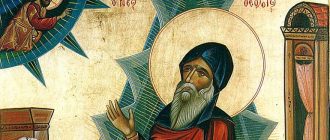
Symeon the New Theologian (949–1022) is one of three saints whom the Orthodox tradition calls «Theologian,» alongside the Apostle John the Theologian and Gregory the Theologian.
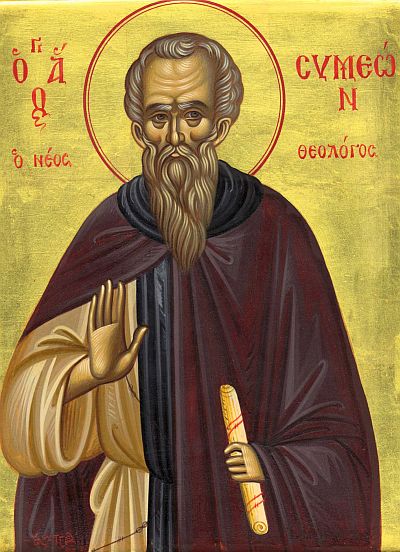
St. Symeon taught that true knowledge of God presupposes personal experience of communion with Him. It is this emphasis on direct spiritual experience that explains his exceptional place in the Orthodox tradition.
Symeon the New Theologian is the only Byzantine monk whose collection of 58 poems points, in its very title, to the vocabulary of eros: Hymns of Divine Eros (Τῶν θείων ὕμνων οἱ ἔρωτες), literally «The Erotes of the Divine Hymns.»
The historian of Byzantine Christianity Derek Krueger draws attention to several features of Symeon’s writings:
— Erotic desire for God. In Symeon, love for God is expressed as passionate desire, longing and thirst for closeness.
— Man and man. Christ and the monk are both male, yet their union is described through images of marriage, embrace, penetration and impregnation.
— The deification of the monk’s whole body. Spiritual transformation embraces the entire person, including his «unseemly members.»
Krueger reads this imagery as homoerotic mysticism: the male body and same-sex desire become the language for describing spiritual union.
The historian stresses that these images should be considered in the context of Byzantine ideas about the body, sexuality and monastic discipline, and not dismissed as «mere metaphors.»
Love for God in Symeon’s Understanding
Symeon’s all-consuming, passionate love recalls the erotic motifs of the Song of Songs, although he does not quote it directly.
«Upon my bed at night I sought him whom my soul loves; I sought him but found him not» (Song 3:1).
Christian exegesis of the Song of Songs (beginning with the Targum, Origen and Gregory of Nyssa) developed the principle that the language of sexual desire is a legitimate and even necessary way to speak of the soul’s movement toward God.
Scholars have long noted that Symeon regularly uses erotic and nuptial imagery to make sense of the relationship between the monk and God. However, researchers have generally failed to notice that a significant part of this imagery has a homoerotic character.
In the Hymns and other works, Symeon describes his mystical experience in erotic and homoerotic terms. Fantasies of the flesh give him vivid metaphors for expressing participation in God.
Symeon’s Beloved resembles a young man. The longing he describes fits patterns of same-sex desire of a man for a youth. This evokes the ancient norms governing relations between a nobleman and a youth of lower social standing, while at the same time subverting those norms.
In Hymn 39 Symeon writes that God’s beauty, «incomprehensible… incomparable,» together with His goodness, kindles desire (Hymns 39.1; trans. Griggs, p. 285).
St. Symeon says to the Beloved:
«The love and longing for You surpass all love and all longing of mortals» (Hymns 39.5–6, trans. Griggs, p. 285).
Thirst for God takes on an erotic coloring: it is directed at the Beloved and expressed in fantasies, longing and the anticipation of closeness.
In the seventh of the Hymns of Divine Love, Symeon the New Theologian plays the part of a lover pining in separation from the beloved:
In me longing is called suffering, and so it truly is. I am tormented because I cannot embrace You whole and be satisfied as I desire; such is my state, and I groan (Hymns 7.17–19; trans. Griggs, p. 57).
His beloved, of course, is God, yet Symeon’s vocabulary and rhetoric draw on the motifs of erotic literature. Speaking in the first person, Symeon voices the lament of a lover that could easily appear in late antique Greek novels or those of the twelfth century, whose intricate plots delight the reader with portraits of lovers’ separation and yearning. The hymn’s discourse on πόθος (longing, yearning, desire) likens love for God to lovesickness and heightens the anticipation of a union that keeps being postponed.
In Hymn 30, in short, rapid verses of Greek, Symeon describes how he weeps and sobs aloud in his cell:
For I sought Him, Whom I desired, For whom I felt passionate love, By whose youthful beauty I was wounded. I was set aflame and burned, All seized by fire (Hymns 30.373–378; trans. Griggs, p. 241; cf. 30.371).
The phrase «felt passionate love» renders the Greek ἔρως.
In the Western Christian tradition, the monk usually saw himself as a soul (Latin anima) entering into marriage with Christ. Symeon, however, uses same-sex desire to emphasize the deification of the monk’s male body. Rather than concentrating exclusively on the soul, Symeon stresses the monk’s male body: God loves and transforms the whole person.
For Symeon the body is not a «prison of the soul» but a participant in deification. After the monk’s purification,
«divine and immaterial fire is united with the soul… and the body, too, becomes fire through participation in the divine and ineffable light.»
The Parable of the Rebel
In his Ethical Discourse 10, Symeon uses a parable to shape monastic spirituality. Krueger interprets this parable as an imaginative representation of same-sex desire.
By presenting the monk’s body as an object of divine eros, the parable takes up themes that also appear in Symeon’s hymns.
As a whole, Ethical Discourse 10 develops the idea of the «Day of the Lord,» when all the saved will be united with God. Symeon emphasizes the role of the repentant sinner in salvation. He calls his own story a paradigm, an «illustration» or «example.»
To show the joy God can feel at the return of a rebellious servant, Symeon weaves in echoes of the parable of the prodigal son. The narrative then grows steadily more intimate: the emperor and the rebel end up in one bed.
The parable tells of an «emperor of the Christians» and a rebel who fought against him for many years. After many years the rebel became disillusioned with his own rebellion and resolved to submit to the emperor, who had repeatedly sent him invitations. He believed the emperor would not hold his belated answer against him, since he had heard of the ruler’s compassion and kindness.
The imperial setting of the parable may reflect the political and military realities of the Eastern Roman Empire at the start of Basil II’s reign, when rebels fighting against the emperor went over to his side. It is notable that Basil remained a bachelor all his life, and rumors of a vow of celibacy he had taken were a subject of gossip.
«A certain man served the enemy and apostate of the Christian king, won many victories over that king’s servants, and was in great glory and honor with that apostate and his army. The Christian king sent to him, inviting him to return and promising great favors, even to the point of receiving him as a partner in his kingship, but he not only refused to go over to the king, but on the contrary mounted still stronger attacks against him. As time went on, one day he came to himself, repented of everything he had done, and resolved to flee and come to the king of his own accord, reasoning with himself: I believe he will forgive me too and fulfill everything he promised before. As he conceived this in his mind, so he did in deed: at once he rose and went to the king, and having come, fell at his feet, begging forgiveness with tears. Then that most kindly king received him, beyond all his expectation, with the greatest joy, marveling at his change and humility, that instead of presenting himself with claims and demanding honors for having shown such love and faith toward him, he, having left his enemy and come to him, lay at his feet weeping and contrite in heart for the many evils he had done before. Therefore, raising him up, he fell on his neck and long kissed him (Luke 15:20) and his eyes, full of tears, and then commanded that a crown, royal robe and shoes be brought, all like his own, and himself clothed in all this his former enemy and adversary; he reproached him for nothing at all of what he had done, but rejoiced and made merry with him day and night, embraced him and kissed him on the mouth, and conceived such love for him that even when he went to sleep he did not part from him, but lay down together with him, wrapping him on all sides in royal coverings, guarding like the apple of his eye every member of his body… In the same way the God who loves mankind receives and loves those who repent, who flee from the devil and come to Him, the true King and God» (Ethical Discourse 57).
This interpretation makes God’s embrace available to every ascetic. Symeon often describes the monk as «naked before God,» either stripped of worldly things or risen naked before God on the Day of Judgment (Hymns 21.361; 28.51). Here, however, nakedness carries a clearly erotic charge, since the naked and repentant rebel is destined for God’s bed:
«So, my beloved brothers, let us leave everything and run naked, let us flee to Christ the Master and, falling at His feet, weep before His goodness, so that He, seeing our faith and humility, may receive us just as, or even better than, the aforesaid king received his enemy, may honor us and adorn us with His own robe and crown, that is, with His glory, and make us worthy of His heavenly bridal chamber» (Ethical Discourse 57).
In this parable Christ’s beloved remains a man; he is not transformed into a bride and not identified with his (grammatically feminine) soul. Even though Symeon’s own interpretation invites his audience to read the parable in the context of marriage, this passage at least calls on the reader to stretch the meaning of «bridal» to include homoeroticism.
This paradigm of the repentant sinner recalls the parable of the prodigal son.
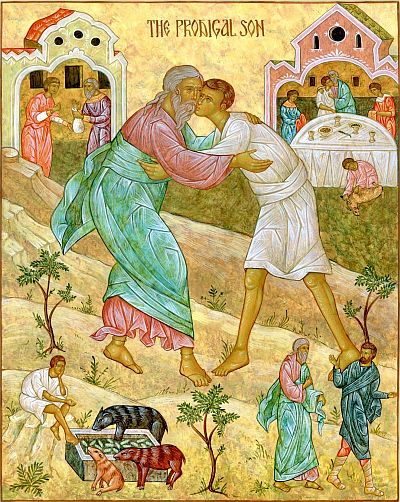
But, as Symeon himself says in his parable, «not only this.» Within a few sentences this image of parental love turns into a picture of same-sex erotic attraction and activity.
How does Symeon move from the model of a father embracing and clothing his son to that of intimate bedfellows?
Symeon’s allusion to the prodigal son occurs in the context of the emperor dressing his subordinate in splendid garments. The abrupt shift from this scene to the dressing and adorning of a bride or bridegroom for a wedding recalls Isaiah 61:10. In the Septuagint the text reads:
«Let my soul rejoice in the Lord, for He has clothed me with the garment of salvation and the robe of gladness; as a bridegroom He has set a crown on me, and as a bride He has adorned me with ornaments.»
Salvation is expressed here through the image of marriage. Interestingly, the habit of repetition with variation in Hebrew poetry makes the beloved in the Isaiah passage first a bridegroom and then a bride, or perhaps both at once. The resulting ambiguity about gender provides a biblical perspective that allows Symeon to turn the monk into Christ’s bridegroom rather than his bride.
In Hymn 15 Symeon allows some flexibility in the image of the monk as Christ’s beloved when, despite his male body and decidedly male member, his soul becomes the bride of Christ:
«And indeed He becomes the bridegroom, and the brides are the souls of all those with whom the Creator is united, and they with Him in turn, and (then) the marriage takes place» (Hymns 15.220–225).
The second garment in Symeon’s story of the emperor is the chlamydion, an outer garment or cloak that was also used as bedding. The emperor covers the rebel with his chlamydion. The two remain in one bed, and the cloak conceals their bodily closeness.
As in many ancient cultures, Byzantine men commonly shared a bed without having sexual relations.
In the parable, however, the bed shared by the rebel and the emperor becomes a marriage bed. Covering one person with another’s cloak carries sexual overtones in certain biblical contexts (for example, in the Book of Ruth).
Both Ruth and the rebel approach the «feet» of a patron of higher standing and are later covered with cloth for the sake of erotic activity.
The closeness described goes beyond the strict limits on monks’ contact that Symeon lays down elsewhere. Earlier in the sermon he strictly regulated contact among monks, insisting that monks never enter another monk’s cell without the abbot’s permission:
«When you go there, take care neither to speak nor to hear a word beyond the necessity for which you were sent. Having carried out your errand, return quickly» (Catechetical Discourses 26.3).
Even outside the cell a monk was not to speak with a brother alone.
The parable allows a reading in which Symeon draws on images of male intimacy familiar to his monastic audience.
How are we to understand that the emperor’s face is «on all the members» of the repentant rebel?
One difficulty is the use of the term μέλος, «limb,» rather than «torso.»
Under the influence of the Apostle Paul’s epistle, the list of body parts in Hymn 15 and Ethical Discourse 4 includes the «unseemly members [μέλη τοῦ σώματος ἀσχήμονα].»
«And those members of the body that we think less honorable we clothe with greater honor, and our less respectable members are treated with greater respect, whereas our more respectable members do not need this» (1 Cor 12:23–24).
In Paul’s reasoning, the members of the body include shameful parts that are normally covered, that is, the genitals.
In his writings Symeon insists on Christ’s presence in the monk’s body,
«even in those parts that are not usually associated with what is exalted.»
«We become members [μέλη] of Christ, and Christ becomes our members. And my hand, the hand of a most wretched man, is Christ, and my foot is Christ. And I, miserable as I am, am Christ’s hand and Christ’s foot. I move my hand, and my hand is the whole of Christ, for the divine Godhead, grant it, is indivisible; I move my foot, and behold, it shines as He does… In this way all the members of each of us individually will become members of Christ and Christ our members; and all the unseemly (members) He will make seemly, adorning them with the beauty and glory of (His) Godhead… So are you not afraid, or not ashamed, (to admit) that my finger is Christ, and the generative member?» (Hymns 15 (58).141–159)
For Symeon, the flinching or blushing of his imagined interlocutor has doctrinal consequences, because denying God’s presence in the generative member leads to denying the Incarnation and therefore to heresy. If Christ is present in the believer, He is present entirely, and so there is no part of the body where He does not dwell.
Symeon says:
«But God was not ashamed to become such, and you are ashamed to be like Him?»
Symeon then quotes the words of his interlocutor:
«It is not that I am ashamed to become like Him, but that He should become like the shameful member [cf. 1 Cor 12:23]; I suspected that you had uttered blasphemy» (Hymns 15 (58)).
Echoing the Apostle Paul, Symeon maintains that there is nothing shameful here, since the genitals
«are members of Christ, the hidden ones too, for they are covered; and therefore they are more important than the rest, as invisible to all, hidden members of the Hidden One» (Hymns 15.168–170).
Thus the generative member, hidden from sight, is paradoxically one of the most fitting images of the hidden God. Symeon’s interest in the divine and deified penis goes beyond simple anatomy: he also allegorizes its physiology.
«Hidden members of the Hidden One, from whom in divine union the divine seed is given, awesomely [φρικτός] imagined in the divine image, (given) from the Godhead Itself» (Hymns 15.171–74).
Symeon describes the emission of the divine seed as φρικτός («causing a shudder»), which makes his images shocking and trembling-inducing at one and the same time. This awesome mystery is at once penetrative, seed-emitting and nuptial, uniting the monk with Christ through the transmission of seed:
«He who is united with us, O fearful mystery! And truly a marriage takes place, ineffable and divine. He unites, I shall say it again, with each one separately, and each one, by reason of pleasure, is united with the Master» (Hymns 15.175–78).
It is easy to find parallels between the biblical image of God’s seed and Symeon’s erotic mystical imagery. The Apostle John wrote of the person born of God:
«Those who have been born of God do not sin because God’s seed (σπέρμα) abides in them» (1 John 3:9).
Here σπέρμα means «seed,» including the male seed involved in conception.
Symeon’s theological interest in the monk’s penis is also present in his Ethical Discourses. In a related passage of Ethical Discourse 4, Symeon presents a list of body parts as a catalogue of virtues. As the translator Golitzin wrote, Symeon «compares the various limbs and organs of the human body with the merits of the perfect Christian.» Symeon says:
«The feet, ankles, calves, knees and thighs are dispassion, nakedness, voluntary exile, voluntary submission for the sake of Christ, obedience, diligent service.»
Symeon includes the monks’ genitals in his discussion, again recalling the language of the First Epistle to the Corinthians, chapter 12:
«The members and parts [μέλη καὶ μόρια] which we conceal are the unceasing prayer of the mind, the sweetness that comes from tears, the joys of the heart and its inexpressible consolation.»
The organs of the body represent the monk’s highest virtues. Turning to the rest of the body (with the exception of the head), he declares the body «perfect in all its members.»
In Hymn 15 Symeon declares that each of us
«will be wholly like Christ in our whole body, and each of our members will be the whole Christ» (Hymns 15.156–57).
Thus in Hymn 15 Symeon presents the union of man and Godhead, stressing God’s presence in the monk’s body, including his generative member. But in Ethical Discourse 10, God is found not in the monk’s body but rather beside it, desiring and embracing it.
Another scenario of erotic encounter between the human body and the Godhead is described in Hymn 16, where Symeon portrays God as both within him and lovingly uniting with him:
«He Himself appears within me, shining in my wretched heart, illuminating me on every side with immortal light and lighting all my members with rays. Embracing me wholly, He covers me all over with kisses (ὄλον καταφιλεῖ με) and gives His whole Self to me, unworthy as I am. And I am sated with His love and beauty, and filled with divine delight and sweetness. I become a partaker of light and glory: my face, like that of my Beloved, shines, and all my members become light-bearing» (Hymn 16 (no. 7)).
Here Symeon develops the theme of perichoresis (mutual indwelling) in love: «You in me, and I in You.» He uses the word «sweetness» (γλυκύτης) as the characteristic mark of God’s presence. The erotic symbolism reaches the level of mystical marriage: the soul calls Christ its «sweetest Bridegroom» and «beloved.» Particular emphasis falls on the «intoxication» (μέθη) of divine love, which displaces all worldly attachments. This state is described as a loss of self-control, but not in a sinful sense; rather, in the sense of complete trust and submission to the will of the Beloved. Symeon asserts that only one who has been «wounded» by this love can understand it; for everyone else it remains hidden.
The mutual interpenetration of man and Godhead takes place both from within and from without, through God’s dwelling in the monk’s body and erotically taking possession of it. All the members of the body glow with divine light.
When in Ethical Discourse 10 the emperor of the Christians is «guarding like the apple of his eye every member of his body,» Symeon illustrates God’s desire to possess the monastic body. This act completes the union of monk and God.
But what does it mean when the lover «places his face» on all the members of his beloved?
In the literal sense, and at the very least, this passage describes a kind of smelling, a loving touch of the face to the partner’s body. Elsewhere in the discourse God’s face itself becomes the object of desire:
«I felt joy and happiness within me, thanks to the ‘opening and appearing of His face'» (Ethical Discourse 10.287–289).
Is «the joy of the face seen» a euphemism?
There is evidence in the passage that Symeon has something more in mind. «Placing the face» of one upon the members of the other includes kissing parts of the body, including the genitals. The scene on the emperor’s bed is preceded by two earlier descriptions of physical intimacy.
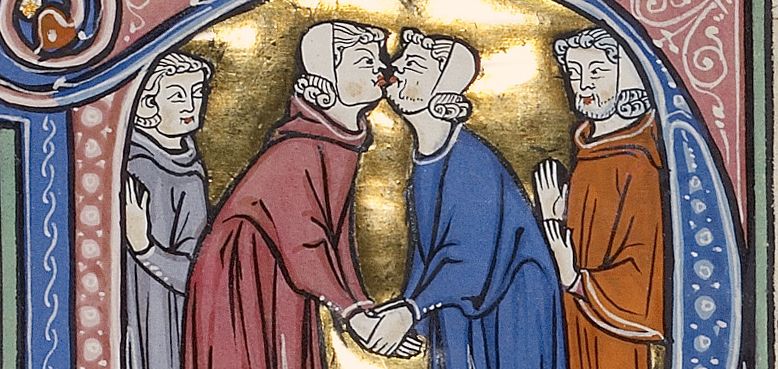
First, in the opening scene the emperor falls on the rebel’s neck and «kisses him,» including on his eyes. Then Symeon describes something repeated and habitual.
The passage says that «night and day» the emperor
«embraced and kissed» him, «mouth to mouth [στόμα πρὸς στόμα].»
Repeated kisses on the mouth reinforce the erotic reading of the scene even before the emperor takes the former rebel to his bed.
The continual, «day and night,» mouth-to-mouth kissing is a medieval Byzantine foreplay leading to bedtime activities that express the emperor’s supreme love.
Symeon invites the reader to imagine this intimacy in the context of the «heavenly bridal chamber,» lending the relationship between emperor and rebel an erotic tint.
What does the emperor do under the cloak? What could a Byzantine monk imagine about the actions of two men in bed?
In Hymn 16 the monk is pierced and inseminated by God. In the parable, on the other hand, the loving touch of the face does not by itself match expectations of nuptial pleasures. What happens in the emperor’s bedchamber is veiled in mystery.
Symeon leaves the scene unfinished, allowing the reader to imagine the nature of the intimacy.
Let us add that the parable does not confine the reader’s interest to the rebel’s experience alone. It also presents Christ’s love for the sinner as homoerotic longing. «Seized with unexpected joy,» Christ does not merely greet His prodigal son but embraces him and kisses him, refusing to part from him, lying with him on the bed beneath His own cloak. Christ’s passion, if you will, is fulfilled in the bedchamber, in His ardent embraces. Moreover, Christ’s continual nuptial activity includes (at least) the touch of His face to the members of His beloved. The King of Heaven expresses His desire for the monk’s whole body by honoring all his members, perhaps bestowing the greatest honor on the most hidden parts.
The meaning of such an act in the Byzantine context is not entirely clear. At that time sexual activity continued to be understood as something a nobleman did with a subordinate for his own satisfaction.
As with the descent of the Son of God from heaven in the Incarnation, His adoration of the monk’s body takes place through humility.
Conclusions
Of course, on some very simple level, a reader or listener of Ethical Discourse 10 is not meant to take the parable of the emperor and the rebel literally; it is, after all, a parable. But as a parable, this soteriological fantasy depends on a number of plausible antecedent images: the emperor and the rebel; rites of clothing and biblical passages about garments, salvation and marriage; and the human desire for physical closeness with other human beings.
As Krueger has shown, in the Tenth Ethical Discourse Symeon resorts to a homoerotic parable as a means of monastic edification. In this parable (and in its hidden parallel with the final scene of Plato’s Symposium, in which Alcibiades covers himself with a cloak beside Socrates) sexual imagery serves «as a powerful allegory of divine revelation and deification.»
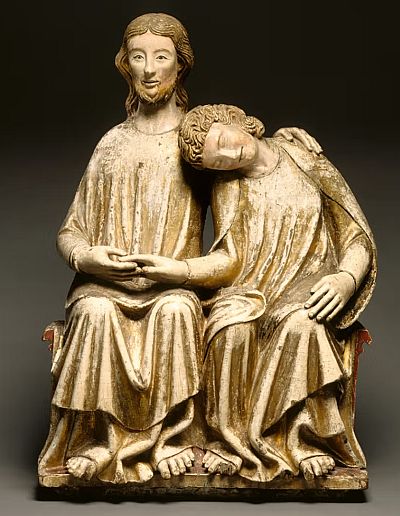
It can be argued that homoeroticism is the most important referent in the parable, since Symeon calls on his audience to identify with what is happening in order to understand Christian salvation. The text of the story models homoerotic desire and at the same time evokes it in its listeners. Understanding closeness with the Godhead in the age to come is presented as a vivid erotic scenario of homoerotic intimacy, which underscores that salvation is bodily and complete, and that God’s love embraces the entirety of the human body in all its members.
St. Symeon also reinterprets the biblical notion of the «seed of God» (cf. 1 John 3:9). This is a difficult passage for scholars. Some see in it an allegory of spiritual birth and «divine communion»; others insist that the bodily image cannot be reduced entirely to allegory.
At the same time, St. Symeon’s texts are not about self-reflection on «sexual orientation» (a category the Byzantines did not know), still less about preaching a carnal relationship. In Symeon, erotic language is subordinated to the task of expressing the inexpressible experience; he is aware of its «scandalousness» and uses it as a rhetorical device, asking the reader directly whether he has been shocked. Symeon’s erotic symbolism serves one function: it makes the union of man with Christ «palpable,» including the monk’s body.
Bibliography
- Greek text of the Theological Discourses of Symeon the New Theologian.
- Krueger, Derek. The Homoerotic Parable and the Monk’s Body in Symeon the New Theologian (Russian translation).
- Krueger, Derek. Monastic Desires: Homoeroticism, Homophobia, and the Love of God in Medieval Constantinople.
- Theological and Ethical Discourses / St. Symeon the New Theologian; trans. from Ancient Greek by Fr. Maxim Mikhailov. Perervinsky Orthodox Theological Seminary. Moscow: Nauka Press, 2017. 311 pp.
- Peers, G. Icons’ Spirited Love // Religion and the Arts. 2009. Vol. 13, no. 2, pp. 218–247.
- Toward a Theology of Eros, ed. V. Burrus and C. Keller. 2020.