Introduction
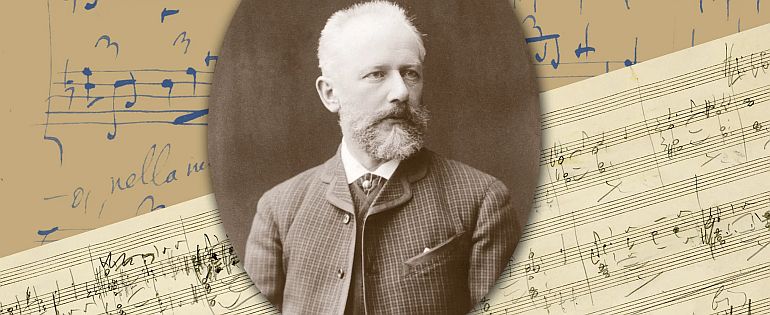
Pyotr Ilyich Tchaikovsky (1840–1893) — Russian composer, conductor, teacher and music critic, one of the greatest composers in the history of world music.
Tchaikovsky’s sexual orientation long ago ceased to be a puzzle for biographers. His own letters and diaries speak clearly enough: he fell in love with men, felt sexual attraction to them, and more than once described his intimate experiences. To this are added the testimony of contemporaries and the recollections of those close to him.
His letters and diaries contain remarkably frank admissions of same-sex attraction, of being in love with particular men, of erotic fantasy and sexual arousal. Some are so direct that later biographers had no need to construct hypotheses about his preferences.
The diaries were first published by his brother Ippolit in 1923. Taciturn as they are, they furnished material for reconstructing his intimate life, including erotic episodes in Russia and abroad. The complete correspondence with Nadezhda von Meck, issued in three volumes in 1934–1936, carried an editorial commentary stating plainly:
«Tchaikovsky was homosexual, and this — both objectively and subjectively — was the source of his greatest tragedy».
In support the editors cited his 1876 letters to his brothers about the reasons for deciding to marry.
Nina Berberova lists the men in his circle for whom he felt a particular fondness: the Moscow cabman Vanya, the bathhouse attendant Timosha, the servant Legoshin, the Klin boy Yegorushka, Sasha the prosphora-baker. She also writes:
«There were encounters in his life with people whose names remained known to no one but himself: in Russia and abroad he had affairs, secretly begun and secretly broken off, of which even Alyosha had no inkling.»
At the same time, «Tchaikovsky’s homosexuality» is an instructive case in the history of scholarship, censorship and politics. Around it grew up an entire culture of silence, euphemism and outright denial that persists to this day. Alexander Poznansky characterised it as
«an elaborate strategy of accumulated silences and falsifications»
— almost without parallel in the history of Russian culture.
1862
In 1862 Tchaikovsky and his acquaintances, the poet Alexey Apukhtin among them, found themselves at the centre of a scandal at the Petersburg restaurant Chotan. What exactly happened there is not reliably known. Modest Tchaikovsky later recalled that after this affair his brother and his friends were
«slandered throughout the city as bugry.»
Pyotr Ilyich was twenty-two. He had already graduated from the School of Jurisprudence and was serving in the Ministry of Justice while simultaneously studying at the Saint Petersburg Conservatory.
The word bugor and its derivative bugromanstvo circulated in educated Russian society as slang for male same-sex sexuality:
French bougre goes back to Latin Bulgarus («Bulgarian»). In the Middle Ages the word was applied among others to the Bogomil heretics, who were accused of sodomy. In time the French word acquired the sense «sodomite.» The Russian slang bugor is usually connected with this word. Hence Russian bugor, bugr, bugroman, bugromanstvo.
When Grand Duke Sergei Alexandrovich was appointed Governor-General of Moscow in 1891, the city joked that
Moscow once stood on seven hills, and now stands on one bugor.
The nickname quickly became part of the composer’s reputation:
«If there is the slightest possibility, try not to be a bugor. It is most sad.» (Letter to Modest, 1870)
Three vocabularies of the period must be distinguished. The legal one said «Buggery (sodomy)», punishable under Article 995 of the 1845 Criminal Code by exile to Siberia. The medical one said «perversion of the sexual sense» (Tarnovsky, 1885). The vernacular said bugor — and in police reports of the 1890s the subculture’s own feminine self-designations stood alongside it: «aunts» and «ladies.»
Tchaikovsky feared the third vocabulary, because it operated not through the courts and not through diagnosis, but through the press and gossip — and because a public career was his only capital.
1875
9/21 January 1875, Moscow (Letter 385 to his brother Anatoly)
«I am very, very lonely here, and if it were not for working constantly I should simply give myself over to melancholy. It’s also true that my damned homosexuality creates an unbridgeable chasm between me and most people. It imparts to my character an estrangement, a fear of people, immoderate timidity, distrustfulness, in short, a thousand qualities whereby I am growing more and more unsociable. Just imagine, I now dwell frequently and at length on the idea of a monastery or something of the sort».
1876
23 June / 5 July, Vienna (Letter 476 to Modest)
«The thing is that my beauty, a high-school student, is due to complete her exams on Monday the 10th. It is impossible for me to leave before that day since she wants* to accompany me to Munich. For my part, I am unable to refuse myself this bliss since up to this day I had had no real thing (namely, an entire night spent together in bed). So I’ll leave here together with her Monday evening; on Tuesday morning we shall be in Munich, where we shall spend the day and stay the night, consequently only on Wednesday shall I leave Munich, directly for Lyons, where I hope to enclose you in my embrace.
*Her wish is my command».
He relates that he was stuck in Vienna and out of boredom went to the circus, where he met someone «very young, fair,» with «hands worthy of the brush of a great artist.»
Poznansky notes that the feminine gender here («beauty,» «high-school student,» «she») is a characteristic euphemism: in the nineteenth-century homosexual subculture men commonly referred to one another in the feminine. The encounter, then, is with a young man — probably a prostitute — with whom he spent his time and planned a journey to Munich for the sake of the «real thing.»
19/31 August, Verbovka (Letter 492 to Modest)
«I am now going through a most critical moment in my life… I have decided to marry. This is inevitable. I must do this, and not only for myself, but also for you, and for Tolya, and for Sasha, and for everyone I love. For you in particular! Buggery and pedagogy cannot go together.»
Tchaikovsky feared that his reputation would obstruct a teaching career: a conservatory teacher cannot be a «bugor.»
The motive for marrying is not personal but familial and reputational, addressed to a brother as accomplice. The letter also concerns Modest’s relationship with his ward, Kolya Konradi.
10/22 September, Moscow (Letter 494 to Modest)
«…from this day forth I shall seriously prepare to enter into a lawful matrimonial union with whomever it may be. I find that our inclinations are for us the greatest and most insurmountable barrier to happiness, and we must fight our nature with all our strength.
This is not for the sake of qu’en-dira-t-on, but for your own sake, for your peace of mind… Here your religiosity should, I suppose, be a firm support to you.
As for me, I shall do everything possible to marry this year, and if I lack the courage for that, then in any case I abandon my habits forever and shall try to stop being counted among the company of Gruzinsky and co[mpany].»
«With whomever it may be» is the programmatic formula of a lavender marriage. Religion here becomes a support for Modest in the struggle with his own attractions. Pyotr Ilyich speaks of the similarity of the two brothers’ inclinations. He intends to marry a woman in order to change his life, and simultaneously urges Modest to break off his relationship with Kolya Konradi.
28 September / 10 October, Moscow (Letter 501 to Modest)
«There are people who cannot despise me for my vices only because they came to love me when they did not yet suspect that I am in essence a man with a lost reputation…
Do you really think that I’m not oppressed by this awareness that they pity and forgive me, when in fact I am guilty of nothing! And isn’t it really dreadful to think that people who love me can ever be ashamed of me! But, you see, this has happened a hundred times before and will happen a hundred times again. In a word, I should like by my marriage, or in general an open affair with a woman, to hush the mouths of various contemptible creatures whose opinion I don’t value in the least, but who can cause pain to the people close to me.
I’m so set in my habits and tastes that it isn’t possible to cast them aside all at once, like an old glove. And besides, I’m far from possessing an iron will by any means, and since my letters to you I have already given in to the force of my natural inclinations about three times. Just imagine! One day I even went to Bulatov’s country estate, and his house is nothing but a pederastic bordel [«a homosexual bordello»]. As if it were not enough that I had been there, I fell in love with his coachman like a lady-cat!!!
So you’re quite right when you say in your letter that it is not possible to restrain oneself, despite all one’s vows, from one’s weaknesses.
I shall not enter into any lawful or illicit union with a woman without having fully ensured my own peace and my own freedom.»
Answering Modest’s objections, Tchaikovsky lays out the logic of the lavender marriage: a public shield, with an explicit reservation preserving personal freedom.
His reasoning about what has happened is paradoxical: he speaks the language of guilt and repentance, as if repeating internalised social and moral norms, and then immediately declares that he is guilty of nothing.
Modest had predicted for him the fate of Kondratyev and Bulatov, married homosexuals — and Bulatov here is that same Mikhail Bek-Bulatov. He went to visit precisely the man whose fate he had been warned against, and fell in love with the coachman.
Awaiting the marriage, he writes to Modest:
«I hate that beautiful stranger who will force me to change my way of life and my surroundings». (Complete Collected Works, VI: 71)
1877
19/31 January, Moscow (Letter 538 to Modest, on the violinist Iosif Kotek)
«To whom else but you can I entrust the sweet secret of my heart! I am in love, as I haven’t been in love for a long time. Can you guess with whom? I have known him for six years already. I always liked him, and on several occasions I have felt a little bit in love with him. That was like a trial run for my love. Now I have momentum and have run right into him in the most decisive fashion.
I cannot say that my love is completely pure. When he caresses me with his hand, when he lies with his head on my chest and I play with his hair and secretly kiss it, when for hours on end I hold his hand in my own and tire in the battle against the urge to fall at his feet and kiss these little feet, passion rages within me with unimaginable force, my voice shakes like that of a youth, and I speak some kind of nonsense.
However, I am far from desiring physical consummation. I feel that if that occurred I would cool to him. I would feel disgusted if this wonderful youth stooped to sex with an aged and fat-bellied man. My only need is for him to know that I love him endlessly and for him to be a kind and indulgent despot and idol.
Lord, how pitiful they all seemed to me in their cynical and prosaic debauchery! (on the company at Strelna) For God’s sake don’t let Alina catch sight of this letter».
Testimony to a strong erotic and romantic infatuation, but not to sexual contact. The subject is Iosif Kotek, a student at the Moscow Conservatory.
His contemporary A. V. Amfiteatrov, attempting to make sense of it, concluded that there was in him a peculiar «Platonic» dimension:
«Tchaikovsky was given to a spiritual, ideal homosexuality, a Platonic ephebism. Forever surrounded by young friends, he forever fussed over them tenderly, attaching himself to them and attaching them to himself with a love more passionate than friendship or kinship.»
Platonic ephebism here means tender, non-sexual, friendly relations between adults and adolescents.
23 May / 4 June (letter to Modest)
His infatuation with Kotek had somewhat abated after he saw the violinist’s damaged finger, but but for that circumstance he would have been
«in love to the point of madness.»
The wedding to Antonina Milyukova took place on 6 July, and the day was for him a hard one.
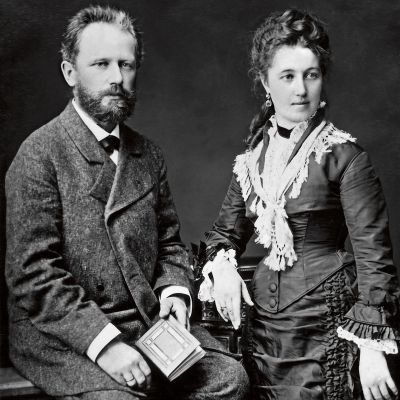
11/23 July, Saint Petersburg (Letter 581a to Anatoly)
«I am indeed going through a difficult moment in my life, however I feel that little by little I am growing accustomed to my new situation. This would be utterly false and unbearable if I had deceived my wife in anything, but I have warned her that she can rely only on my brotherly love. The attack was not resumed. Since the first attempt, my wife has become totally repugnant to me in the physical sense. I am sure that sometime later the attacks will resume and prove more successful. But for now any attempts would be useless.
Yesterday morning, while my wife was taking a bath, I went to mass at St Isaac’s Cathedral. I felt the need to pray.»
A strange mixture in a single letter: mass at St Isaac’s five days after the wedding, between a paragraph on physical repugnance towards his wife and a paragraph on plans to live with her without sex.
13/25 July, Saint Petersburg (Letter 583 to Anatoly)
«I’m already starting to relate to her as any husband who isn’t in love with his wife.»
The previous day had been the hardest since the wedding: he was getting drunk every evening in order to sleep, and wrote that the crisis might have ended in illness or madness.
9/21 September, Kiev (Letter 599 to Modest)
«As regards my source of delight, about whom I cannot even think without my cock coming to attention [«without being sexually aroused»], and whose boots I would happily clean all my life long, whose chamber pots I would take out and generally lower myself anyhow, provided that I could be allowed, even if only occasionally, to kiss his hands and feet — she was present at the hunt. Today I received a letter from my spouse. She writes that she cannot wait for me to come. I depart tomorrow morning.»
Here again he uses feminine forms («my delight,» «she»), although the object of his infatuation is the young footman Yevstafy Krivenko. The expression delat’ na karaul refers to the military command «present arms»: the soldier straightens to attention. The phrase means literally: «I cannot think of him without getting an erection».
He reveals a particular aspect of his infatuation: an erotic fantasy of submission to the beloved man, a readiness to serve him and accept a humiliating position for the chance to touch and kiss him.
And one paragraph later he writes of returning to his wife. (He would live with Antonina only from 12/24 to 24 September / 6 October.)
Biographers describe the marriage as an attempt to change his nature, one that ended in severe crisis. A story later arose that he attempted suicide by standing at night in the cold Moskva River. There is no documentary confirmation of this story: in Poznansky’s view it goes back to the late recollections of Nikolay Kashkin.
26 October / 7 November 1877. He writes to Modest that his wife’s latest letter
«is remarkable in that from a sheep, who had moved you so much that even in the distant future you supposed a reconciliation between us possible, she has suddenly turned into a most ferocious, cunning and sly cat. I turn out to be a deceiver for having married her in order to mask myself, she has suffered much at my hands, she is horrified by my shameful vice, etc., etc. Oh, what filth! But the devil take her».
Antonina continued to turn to him for financial help. She had three children by another man; later she asked the composer to take in her youngest daughter, but he did not agree. After his death her mental condition deteriorated. In 1896 she was placed in a psychiatric hospital, and in 1901 transferred to the Udelny Home for the Care of the Mentally Ill. She spent the last ten years of her life there and died in 1917.
1878
13/25 – 14/26 February, Florence (Letter 759 to Anatoly)
«Only now, especially after the story with my marriage, am I finally starting to understand that there is nothing more fruitless than wanting to be something other than what I am by nature».
The sentence stands at the end of a list of his own unrealised ambitions — to be the foremost composer, a conductor, a man of the world. Biographers read the reference to «the story with my marriage» as a final acceptance of his sexuality after the attempt at «correction.»
5/17 – 8/20 March, Clarens (Letter 779 to Anatoly, on Kotek)
«…thirdly, I love him very, very much».
He admits that he loves him differently than before, and is angry with himself and with him because he cannot tell him the whole truth. Irritation gives way to exaggerated tenderness; Kotek’s presence is necessary for work on the violin concerto.
16/28 August, Brailov (Letter 898 to Modest)
«Glinka was wrong to call himself a mimosa. It is not he, but I, who is the mimosa. Only in the expanse, silence and solitude of the country could I open my leaves and live a normal life.
Regarding love, I must say that I’ve now reached the ultimate extreme of lust. I cannot think about Yevstafy without an insane desire. I fall in love with all the boys I meet. Even the portraits of Nadezhda Filaretovna’s sons. Onanism no longer satisfies or soothes me. So I have given it up. I’m terribly afraid that I’ll be unable to restrain myself in Verbovka and encroach on the immaculate moral purity of the house».
A year after the catastrophe of the marriage, no «change of nature» has occurred. There is self-irony, and fear for his sister’s household: he dreads being unable to restrain himself at Verbovka.
Lev Klein’s comment:
For others, like Tchaikovsky, the mismatch between their feelings and the demands of the social norm was a source of suffering, and they sought cover or cure in marriage. This drove Tchaikovsky’s wife into the madhouse, and brought Tchaikovsky and K. R.* to recognise at last the impossibility of fighting their nature.
*K. R. — Grand Duke Konstantin Konstantinovich Romanov (1858–1915).
29 August / 10 September 1878 (letter to Modest)
After a feuilleton about the Moscow Conservatory which, following talk of the professors’ amours with young ladies, added: «There are amours of another kind at the Conservatory as well, but for a very obvious reason I shall not speak of them,» Tchaikovsky writes:
«…that sword of Damocles in the form of a newspaper insinuation, which I fear more than anything in the world, has struck me on the neck again. Granted, this time the insinuation does not touch me personally, but that is worse. I bore it heroically and philosophically… but in my soul cats were scratching. My bugor reputation falls upon the whole Conservatory, and that makes it still more shameful, still harder for me».
1879
26 December 1878 / 7 January 1879, Paris (Letter 1040 to Modest)
«What a voice, what a smile, what movements, gait, gestures!»
— on the actor Boucher, a «divine being»:
«What I wouldn’t give for the hand which inflicts the insult on Got to slap me a hundred times every day!»
The same letter notes that Kotek has become infatuated with girls.
22 February / 6 March, Paris (Letter 1118 to Modest)
«I’ll be spending several pleasant hours with her before leaving» (of «Mademoiselle Louise»).
Poznansky holds that in the letters of 1879–1880 this feminine name describes an affair with a young Parisian prostitute.
26 February / 10 March, Paris (Letter 1124 to Modest)
«Finally we reached rue de Maine… And nonetheless at that moment I felt that this miserable room was the focus of all human happiness. He (I can’t use the feminine pronoun talking about that dear person) immediately showed me his passport… Then there were various calinerie, as he put it, and then I became possessed with amorous happiness and the most improbable pleasure was experienced. With no exaggeration, I can say that it has not only been a long time but that I have almost never been as happy in that sense as yesterday.»
The French câlinerie means tendernesses, caresses, tender touch, amorous coaxing.
He first uses the feminine name «Louise», then expressly corrects himself. This makes the letter an especially valuable witness to his same-sex erotic experience. He then describes the morning after:
«However, I awoke at seven o’clock, with a terrible weight in my head, with tedium, with pangs of conscience, with a full consciousness of the falsity and exaggerated nature of the happiness I felt yesterday and which, in essence, is nothing but a strong physical attraction founded on the fact that Luisa corresponds to the capricious demands of my taste and on his prettiness in general.
However that might be, the youth has much that is fine in the root of his soul. But my God, how pitiful, how profoundly debauched he is! And instead of encouraging his improvement, I only help him to descend further downwards. I shall tell you at our meeting many charming details bearing witness to his naivety combined with debauchery».
1880
9/21 August, Kamenka (Letter 1560 to Modest)
«I’ve paid my debts to Alyosha and Yevstafy, with whom I’m more in love than ever. Lord, what an angelic creature he is, and how I should like to be his slave, his thing, his property!
When I read about the episode with Vanya in your letter, I immediately became inflamed with an ephemeral passion for him. Everything is ephemeral, everything is transient, and only Ostapkin’s beauty is absolute, before which I shall grovel in the dust my whole life».
«Ostapkin» is Yevstafy’s pet name. Note the quasi-religious vocabulary: angelic, absolute, grovel in the dust. The repeatability of erotic infatuations is plainly visible: a strong attachment to one person and the almost instantaneous arising of a new passion for another.
1882
8/20 December, Moscow (Letter 2171 to Modest)
«…the desire to go to a church concert on Friday, where they are singing part of my Vigil…
…I have even gone binging with him twice, and with Golitsyn and three molto belli cocchieri in Saratov. Uno di questi tre mi piace moltissimo e sono un poco innamorato.
But this whole life, in which there are many pleasant hours — and even more painful ones — is extremely wearying to me et je soupire, après ma liberté.
Take note that I want to live with you for at least 3 days incognito».
The intimate episode he unexpectedly describes in Italian: «One of these three [coachmen] I like very much, and I am a little in love». Perhaps a foreign language let him speak of it more freely. Alongside it stands his own Vigil at a church concert and the demand for incognito. A single letter holds both lines: churchliness and a concealed private life.
1886
The historian Lev Klein, in The Other Side of the Luminary, cites the diary entries.
On the boy Yegorushka Tabachka — 8 August 1886, an estate near Klin:
«After dinner walked into town via Prasolovo, hoping to see the person who interests me.»
The next day:
«After dinner walked to Klin… Back via Prasolovo. Saw Yegorushka, asked and received double.»
Of the young cabman Ivan, on 2 September:
«Unexpectedly Ivan. Glad. Park. A long walk in the woods.»
Then a cryptic entry:
«In love with Vu. Wavering. Virtue triumphs.»
Klein suggests that «Vu» is «Vanechka.» Virtue did not triumph for long.
14 September:
«My Vanya. All sorts of visits to taverns. To the point of disgrace.»
The next day, a happy meeting with Vanya, followed by a sleepless night:
«A misunderstanding with Vanya. Find him at the entrance on my return. A very pleasant and happy moment of life. But then a sleepless night, and what torment and anguish I felt that morning — this I have no power to express.»
16 September: «A feeling of anguish. Searching for Vanya near the hotel.»
17 September: «Vanya. Home.»
1893
17/29 May, London (letter № 4935 to Vladimir «Bob» Davydov)
«It’s with a sort of delectable pleasure that I write this to you. The idea that this piece of paper will be in your hands, at home, fills me with joy and brings tears to my eyes.
I’m suffering not only from an anguish which cannot be expressed in words (in my new symphony there is a place which I think expresses it very well)…
My joy, please write to me right away, even if it’s just a few words… Hugging you to death.»
One of the most emotionally charged addresses to his nephew in the last year of his life, reflecting a deep emotional and erotic attachment that persisted to the end. But the erotic character of these feelings does not prove the existence of sexual relations between them.
Poznansky concludes:
«The evidence adduced leaves no doubt that the composer not only adored Bob but was in love with him with all the passion of which he was capable».
What Was the Composer’s View of God and the Church?
Let us trace the line through several examples.
1. 1875: bugromaniya and the thought of a monastery
«It’s also true that my damned homosexuality creates an unbridgeable chasm between me and most people. It imparts to my character an estrangement, a fear of people, immoderate timidity, distrustfulness, in short, a thousand qualities whereby I am growing more and more unsociable. Just imagine, I now dwell frequently and at length on the idea of a monastery or something of the sort.»
What matters is in what capacity the monastery is mentioned: not as a field of struggle, not as a vocation, but as an exit from unsociability — «or something of the sort.» The cloister stands in the same row as any other form of escape from people. Tchaikovsky perceives the churchly as a means — an anaesthetic, a refuge, a «support» — but not as a path with a goal and a price.
2. Faith as an instrument, recommended to someone else
«You will say that at your age it is hard to overcome the passions; to this I answer that at your age it is easier to direct your tastes another way. Here your religiosity should, I suppose, be a firm support to you.
I think exclusively of eradicating my pernicious passions.» (Letter 494 to Modest, 10/22 September 1876, Moscow)
The vocabulary is familiar to any reader of ascetic texts: passions, overcome, eradication. But his faith is not addressed to God — it is offered to his brother as a lever. Not «I shall pray,» but «your religiosity should be a support to you.» A support holds up a wall; it changes nothing.
Two weeks later he reports honestly that the lever did not work:
«…have already given in to the force of my natural inclinations about three times.» (Letter 501)
3. The rejection of Christian dogma
23 November / 5 December 1877, Vienna (Letter 659 to N. F. von Meck)
«My attitude towards the church is quite different from yours. For me it has retained much of its poetic appeal. I frequently attend mass; the liturgy of Saint John Chrysostom is, in my opinion, one of the greatest of artistic creations.
I am also very fond of the All-Night Vigil… to awaken from this reverie when the choir sings: ‘Since my youth many passions have made war against me’… — oh, I am so awfully fond of all this, it is one of my greatest delights! And so on the one hand I still have strong bonds which tie me to the church, on the other I, like you, have long since lost faith in the dogmas. The dogma of retribution in particular seems to me terribly unfair and unreasonable.
In short, I cannot comprehend individual immortality… Indeed, perhaps there will be no music in heaven. Let us enjoy it here on earth while we are alive.» (Correspondence with N. F. von Meck, vol. 1, 1934, pp. 91–97; Complete Collected Works, vol. VI, pp. 251–257).
He quotes the first half of the stepenna antiphon of Tone 4 and stops. The full text:
«Since my youth many passions have made war against me, but do Thou Thyself defend and save me, O my Saviour.»
The description of the situation is there; the appeal to God is omitted. The petition is replaced by a description of his own enjoyment: «to give oneself up to the enchanting poetry of this psalm.» A psalm about the struggle with the passions became an object of aesthetic experience — and there its action ended.
Four months earlier, in the same year 1877, another testimony:
«Yesterday morning, while my wife was taking a bath, I went to mass at St Isaac’s Cathedral. I felt the need to pray.» (Letter 581a)
The need is registered as the fact of a want arising, not as the performance of an act. This is the characteristic form of the whole body of material: the movement towards the Church is registered; the continuation never is.
4. Christ’s pink thighs and the bribing of a youth
5/17 March 1880, Berlin (Letter 1441 to Modest)
«Much of it has given me genuine pleasure, particularly the Flemish School, but Teniers, Wouwerman and Ruisdael are superior to the vaunted Rubens, whose Christ even has thick pink thighs and unnaturally rosy cheeks.»
A few lines later he tells of a young man of «astounding beauty» to whom money was offered:
«Between dinner and the theatre, I walked and made the acquaintance of an astoundingly beautiful young man. At the end of the walk, money was offered and refused. He does it for the love of art, and adores people with beards.»
Two adjacent paragraphs of one letter may strike some readers as blasphemous.
Yet Rubens’s Christ he rejects for the unconvincingness of the flesh: the thighs, the blush. The young man he accepts by the same criteria — «astoundingly beautiful.» One measure: does it move, does it convince, is it beautiful.
Two years later, the same conjunction — now with a church text of his own composition:
«…the desire to go to a church concert on Friday, where they are singing part of my Vigil…
I have even gone binging with him twice, and with Golitsyn and three molto belli cocchieri in Saratov. Uno di questi tre mi piace moltissimo e sono un poco innamorato.
Take note that I want to live with you for at least 3 days incognito.» (Letter 2171)
His own Vigil, an Italian cipher for the coachmen, and the demand for incognito. This is not hypocrisy: he is not pretending to believe, he genuinely loves the Vigil.
The churchly does not condemn the private; the private has no need of churchly forgiveness.
16/28 September 1878, Moscow (Letter 916 to Modest)
«Due to boredom and unbearable apathy I gave in to the urgings to meet one sweet youth from the peasant class who works as a lackey. My heart moaned sweetly all day since I’m at present quite disposed to falling madly in love with someone. We arrived at the Boulevard, introduced ourselves, and I fell in love immediately, just as Tatyana fell in love with Onegin. His face and figure were un rêve, the embodiment of a sweet dream. After a walk, during which I irrevocably fell in love with him, I invited him… to a tavern… However, he was so handsome, so dear, charming in all other respects, that with the help of two glasses of vodka I was in love and melting by the end of the evening.»
In June 1877 he had written to his brother:
«…my opera… I’ve fallen in love with the image of Tatyana, I’m charmed by Pushkin’s verses, and I write music to them because I am drawn to them.» (Letter 570 to Modest, 9/21 June 1877, Glebovo)
In September 1878, having fallen in love with a footman on Nikitsky Boulevard, he assigns himself Tatyana’s part. In all likelihood the comparison came out of the score he was holding in his hands that very week. He put himself in her place: instantaneous, hopeless love for a stranger on a boulevard.
In those days he goes to church with Nikolay Lvovich — that is, with the same man who arranged the introduction on the boulevard:
«In the evening I go to church with him. Recently we were at an All-Night Vigil at the Cathedral of the Dormition… Moscow is utterly disgusting to me, and for the moment I live…, hiding myself with great care and avoiding any society.»
Tchaikovsky is hiding — but not from God. From Muscovites.
5. The second pole: Konstantin Romanov
A few weeks before his death Tchaikovsky declined to set Apukhtin’s «Requiem.»
26 September / 8 October 1893, Klin (Letter 5046)
«In the Requiem a lot is said about God the Judge, God the Chastiser, God the Avenger (!!!). Forgive me, Your Highness — but I shall venture to point out that I do not believe in such a God, or at least that such a God could not elicit from me those tears, that rapture, that veneration before the creator and source of all blessings, which would inspire me.
…how many times have I dreamt of illustrating through music these words of Christ: ‘Come unto me all ye that labour and are heavy laden’… How much infinite love and pity for man there is in these wonderful, simple words!..»
(K. R. Selected Correspondence, 1999, pp. 84–85; Complete Collected Works, vol. XVII, pp. 193–194)
Here unbelief and aesthetic taste have become functionally equivalent. A theological assertion and a reaction of taste have ceased to be distinguishable.
The letter of 1893 is addressed to no accidental person. Grand Duke Konstantin Konstantinovich — the same vector of sexual attraction, the same epoch, the same milieu, the same fear of exposure; but in him the conflict is formulated differently: not as reputation before people, but as sin before God, and he carries it to confession. On this see the article Grand Duke Konstantin Konstantinovich (K.R.): «My sin is known to no one».
K. R. asks him in a letter to write music for a requiem; Tchaikovsky refuses — and apologises for fearing to «touch indelicately upon your religious sentiment.» He understands perfectly what his interlocutor is asking, and knows precisely that he cannot give it. These two contemporaries diverged very far in their personal experience of faith.
Thus, in discussing Orthodox faith, his tone depends on the addressee. To Modest, diaristic irony and sharp turns of phrase («the vaunted Rubens,» «foreign priests»). In the correspondence with von Meck, a confessional register. To Grand Duke Konstantin Romanov, a respectful but firm refusal.
The organ of God-knowledge in Tchaikovsky was aesthetic feeling: he judges both Rubens and the Latin Requiem by whether it «touches the heart.» Hence his love of the Liturgy and the Vigil alongside his rejection of «the dogma of retribution.»
A reader may get the impression that Tchaikovsky had lost his conscience altogether: he met with young male prostitutes, deceived his wife (as did St John of Kronstadt), and corrupted lads by bribery.
Yet in the Paris letter of 1879 he writes directly of «pangs of conscience» and of how, instead of helping the youth to rise, he «only helps him to descend further downwards» (Letter 1124). There is also a vocabulary of struggle — «the eradication of pernicious passions.» What the composer lacks is a personal bond with God: in none of the letters does an aesthetic experience pass into repentance, or repentance into a petition for grace. The second half of the antiphon is never uttered.
Conclusions
The question of whether Tchaikovsky was homosexual is closed by the documents. His letters and diaries leave no serious doubt. He himself writes of his infatuations, erotic enthusiasms, sexual desires and relations with men. He was not always frank, but in the correspondence with his brothers he permitted himself astonishing directness.
These documents show a man well aware of the social consequences of his sexuality. He feared exposure, worried about his reputation, tried to change his way of life, and even considered marriage as a means of protecting himself and those close to him from gossip. Abandoning his own attractions, however, he could not manage.
His relation to religion was no less contradictory. He loved Orthodox worship, church singing and liturgical poetry, but was critical of Christian dogma, especially the teaching on retribution. His letters let us see how church aesthetics and a private erotic life coexisted in one man.
Herein lies the chief value of his correspondence: it returns to us a living Tchaikovsky — gifted, sensual, at times contradictory, a man whose private life was long subjected to censorship and silence.
P.S.
Minister of Culture Vladimir Medinsky declared that
«there is no evidence whatsoever that Tchaikovsky was a homosexual».
Incidentally, one wonders: in how many churches of the Russian Orthodox Church have Pyotr Tchaikovsky’s musical works not been performed?
Lev Samoilovich Klein asks:
And what of the music? How was homosexuality reflected in Tchaikovsky’s music — in its particular passion, tenderness and lyricism?
«Bob graciously accepted his uncle’s courtship, but was sexually quite indifferent to him, and Tchaikovsky knew it. It was precisely then that he wrote the Sixth Symphony, whose profound tragicism shook its listeners. It is dedicated to V. L. Davydov. When Davydov showed his inattention especially plainly, the composer ordered the dedication removed, but later restored it. The critic V. V. Stasov wrote in 1901:
‘…it is nothing other than a terrible cry of despair and hopelessness, as though saying through the melody of its finale: «Ah, why did I live in this world!»… The mood of this symphony is terrible and tormenting; it makes the listener feel bitter compassion for the man and the artist who had to endure those horrible spiritual torments which are expressed here and whose causes are unknown to us.’
The 1880s were for Tchaikovsky years of creative work — The Maid of Orleans, Cherevichki, Romeo and Juliet, 1812, The Sleeping Beauty, The Nutcracker, the Fifth Symphony. They were also years of conscious and now uncompromising continuation of homosexual activity» (L. S. Klein).
Sources
- Berberova, N. N. Tchaikovsky: The Story of a Lonely Life.
- Klein, L. S. The Other Side of the Luminary: The Unusual Love of Remarkable People. St Petersburg, 2002.
- The Unknown Tchaikovsky. Moscow, 2009.
- Poznansky, A. Pyotr Tchaikovsky: A Biography. 2 vols. Moscow: Vita Nova, 2009.
- Poznansky, A. Tchaikovsky. Moscow: Molodaya Gvardiya / Vita Nova, 2010.
- Sokolov, V. S. «Tchaikovsky’s Letters Without Cuts: Unknown Pages of the Epistolary Record,» in Forgotten and New, vol. I. Moscow, 1995, pp. 118–134.
- Tchaikovsky, P. I. Forgotten and New. Moscow, 1995.
- Tchaikovsky, P. I. Complete Collected Works. Literary Works and Correspondence, vols. V–XVII. Moscow, 1959–1981.
- Tchaikovsky Research (database).
Letter quotations follow the published English translations by Alexander Poznansky, Brett Langston and Luis Sundkvist (Tchaikovsky Research), except as noted.